



The Portugal Diaries – Why so many Americans are choosing Portugal
Patience is the key to living in Portugal for Americans used to snapping their fingers and getting things done quickly. ‘Quick ain’t gonna happen!’. Pour a glass of wine, take a good book and just relax.
Text: Chris Graeme.
Over the years that US luxury real estate agent and entrepreneur Anne Brightman has lived in Portugal she has held many conversations with her fellow citizens and found they all had one thing in common.
They had asked themselves what life would look like if they upped sticks and moved to another country. And one thing stood out. After researching the options, Portugal came up time and time again – not just for the sunny climate and good wine – but because of a plethora of considerations from safety and security to more reasonable private health costs, and a slower, different pace of life, away from the hectic lifestyle in the US where so often people live to work and not work to live.
Which is why Anne, who originally hailed from Texas, decided to launch a series of webinars – ‘The Portugal Diaries’ where she plans to talk to US citizens living in Portugal about their lives, experiences and opinions on what it is like living in another country, warts and all. All aspects from the lens of people who grew up in and lived a completely different reality to the Southern European lifestyle.

I was happy to sit in on the first of these webinars to discover what it actually feels like living and working in the Portugal lifestyle experience.
“This series is not about trying to sell anything. It’s about sharing real experiences, and in each episode, we sit down with Americans and other expats who have already taken that leap and built a life here in Portugal.
“We’re speaking with people who have navigated the murky waters of immigration, experienced firsthand the adjustments that must be made, had their expectations set for them, and sometimes reel from the unexpected surprises”, explains Anne who is the CEO of the Brightman Group, an upmarket boutique estate agency in Estoril and Lisbon.
Anne says these will be everyday moments that make up life in a new country and the first of these up close and personal chats with US relocants started last week and focused on a question that those Americans already living in Portugal get all the time. Why did they choose Portugal? And just why are so many Americans moving here?
“It’s really got to the point that walking down certain streets in Lisbon or Cascais, and certainly in the Algarve, you hear more American English than Portuguese”, remarks Anne whose agency not only helps people buy homes, but primarily helps US citizens through the entire relocation process.

The guests were Dr. Joy Wiggins who has lived and worked in Austin, Seattle and Washington and moved to Portugal two years ago. Joy is a cross-cultural communication and organisational development expert with international teams.
And then there’s Joseph Gonzales, also hailing from Texas, who moved to Portugal in 2022 with his wife and two children after spending several years working in Singapore, where his children were born, and who runs Move Me to Portugal to help people that are considering moving here and understand the lifestyle.
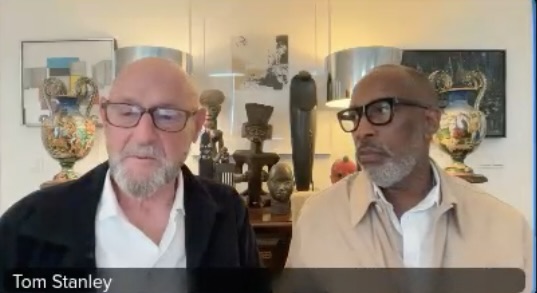
And finally screen writer Tom Stanley and interior designer Ron Woodson, a gay couple from Southern California. Ron has had a practice for 30 years working on design projects globally, and is now doing work in Portugal.
Tom and Ron have been living in Portugal for three years and Tom is now associated with the Escola de Largo, a school in Chiado, and runs the only English language screenwriting group in the country.
“I had loved visiting Portugal multiple times and spent a month here in 2004, and did many business trips. But we decided we wanted to live overseas for the third act of our lives after realising that the United States, Mexico, and other places were not places we wanted to live”, explains Tom.

“We travelled through the south of France and Spain, and then ended up in Portugal. And as soon as we got back in Portugal, we said, “This is home. This feels like home.” This is sort of like California, but everything’s 500 years old”, he recalls.
Finding your tribe
Ron and Tom say they just felt comfortable with the lifestyle, plus they had established a tribe of people including friends Fromm the US and UK and other places who had already been living in Portugal. “We were able to slip in with a crowd of people right off the bat”, he adds.
Ron says “having a community of people here already, I have to say, made it a lot easier for us. We do have other friends who packed two suitcases alone and moved here, and they had a harder time getting acclimatized.
People are very, very friendly here, but I think if you have not done your homework before coming, it may be a little daunting. Once you get in and learn how things work here, it’s more seamless”, he notes.
But what did Joseph’s family and friends say when he told them he was moving to Portugal with his family?
“First they thought I was crazy, or we were crazy for moving to Singapore without kids. And then we said, “We’re not going back to the US with kids.”
Of course, our grandparents and parents were not super happy about that. But now that both our mothers have visited and one of Steffi’s (his wife’s) brothers, and the other brother’s coming this summer, I think they’re starting to see what life is like here, and understand the difference between what we currently have and what we used to have”, he remarks.
A safe environment for kids
One of the things Joseph has noticed is how family-orientated the hotels in Portugal are, often offering kids clubs, which is not the rule of thumb in the US unless staying at a very high-end hotel.
“Here you can drop your kids off while you have lunch or maybe have an adult beverage. So you’ve both adult and kid-friendly atmospheres combined, and I think there’s a lot more amenities that are kid-friendly such as playgrounds”, says Joseph.
But what stood out for Ron as different from California was that he could sit on his own in a park and read a book.
“If as a man in Southern California you sit in a park by yourself, you might be viewed as a child molester or a pervert. It’s just not done,” he remarks.
“Here, people just sit in the parks. I go now and just take a book, or not take anything, and just take in the city. Where we live, there are two parks that are just around the corner, and one has a fantastic view, and I just love to go and sit in that park.”
Screenwriter Tom Stanley
Portugal – more gay friendly
But how does life compare in terms of attitudes for a gay couple like Tom and Ron, and how does the LGBT community differ from in the US?
“It’s very open and comfortable here. We’re in central Lisbon and you see a lot of gay and lesbian couples. I’ve probably seen more trans people here than I’ve seen in my entire life. We’re just treated like anyone else,” says Ron.
Tom agrees. “It’s very normal. We’re not special, we just are, and I love that. That’s ultimately the goal, where everybody can be themselves and just participate in society in a great way and not be looked at. Americans are very suspicious of each other”.
Both say they are concerned about a rolling back of rights for gay people in the US. In Portugal, you can get married and was one of the first countries to allow gay marriage, and people don’t make a big deal about it. “You’re not gay married, you’re just married”, remarks Tom Stanley.
The topic also turns to being a person of colour. “As a black man living in Portugal, I have to say (both on the first time I came here in 2004, and on subsequent visits), how welcome I felt”, says Ron.
“When I get off the plane, I don’t have to worry if I’m going to get pulled over by the police and harassed, or if I’m going to have to deal with extreme racism on any given day.
And I must say, being a black man in America, you armour yourself to go out the door every day because there’s going to be something, whether it’s a micro-aggression or something even stronger”, he adds.
Joseph agrees. “One of the big conversations that we had two years after we had moved here, was exactly what Ron and Tom said about just being a human being walking down the street, and that concern in the US is quite different, because in the US, you’re not just a human being, you are characterised by colour, race, ethnicity, and religion.”

Interior designer, Ron Woodson
Safe for women
The difference in how safe it is on the streets in Portugal compared to the United States is palpable.
“As a woman I feel like I can walk down the street and I do not feel like I have to constantly look behind me and see if somebody’s following me,” says Joy Wiggins.
The other aspect that the communications and organisational expert has noticed is respect by the younger generation for older people.
“I watch people on the bus and they definitely stand up to give a seat for their elders. Even somebody stood up for me the other day and I was like, “Oh hey, I’m not that old. It’s fine.” So, it’s more respectful, I find”, notes Joy.
Red tape and cultural mingling
So, all good so far. But now comes the hard part – the red tape. Tom Stanley finds that immigration is by no means an easy task in Portugal.
“A really important thing is the mindset you have if you do move to Portugal. You’ve got to be open, you’ve got to roll with the punches.”
One of the aspects they all agree on is the importance of cultural mingling. “It’s important to learn the language. I find that expat friends who end up finally making friends with Portuguese people have much richer lives and a better sense of belonging.
If you’re here and going to isolate yourself in an expat community, you’re going to miss out on what a wonderful country and culture this is,” says Tom.
One thing that Anne Brightman notes is that Portugal is not a country where people sue each other over the slightest thing.
“My sister gently knocked the car in front of her, which hit the car in front of him, which hit the car in front of the others. It was a light tap, and the cars were all so close together that the safety bags did not even deploy. She had two lawsuits from that within a week!”
But in Portugal, when to comes to immigration and residence cards, that’s a whole different ballgame.
“We got our residency cards at completely different times months apart even though we applied on the same day and time”, recalls Joseph.
But ends by giving a valuable piece of advice: “You have to leave your American ego of things getting done immediately at home or you’re going to end up drinking a lot of wine and reading a lot of books! ”

Screenshot