


Portugal’s bar association president warns judicial system scaring off overseas investors
Portugal’s slow, cumbersome, over-complicated and archaic judicial, administrative and tax systems are so inadequate and hostile to business and society that they are actively frightening off the very overseas investors the country needs to survive and thrive.
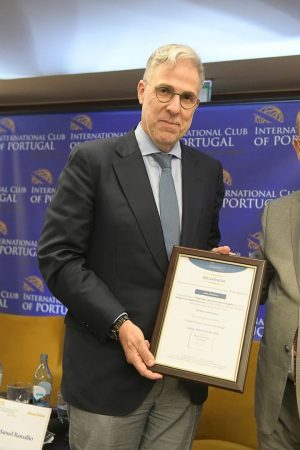
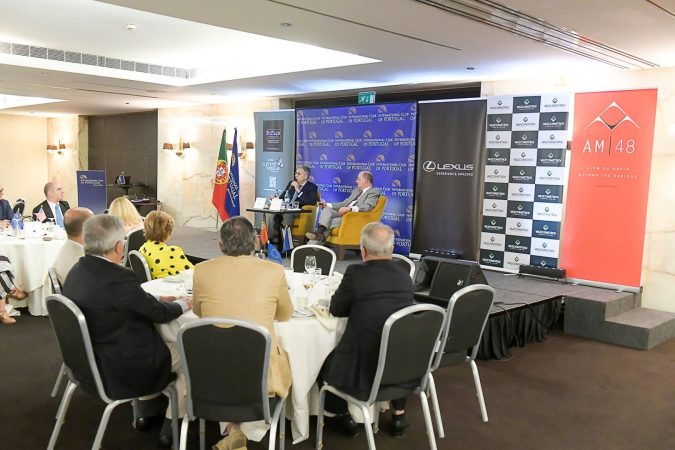
In the year in which Portugal’s Bar Association celebrates its centenary, its president, João Massano, guest speaker at a lunch organised by the International Club of Portugal on Thursday, pulled no punches in a harsh criticism of Portugal’s judicial and administrative systems while admitting that reforming them was a herculean task that he wondered if it could ever be achieved.
Text: Chris Graeme; Photos: Fernando Bento (ICPT)

One of Portugal’s top barristers, João Massano, still recalls that as a law student at university all anyone could talk about was the need for Portugal to reform its administrative, legal and justice system. That discussion has been going in since the 1970s and it’s still going on today.
However – and here’s the rub – there has never been a serious attempt by any government to really do so, other than tinkering around the edges, because, as he says, “it’s impossible to reform the judicial system in an abstract sense”.
And admitted that it was difficult and frustrating for him and the association to have meetings with politicians and see little get done despite everyone knowing what the problems were.
“Changing a simple comma at times takes months”, he lamented, and doubted whether justice reform in Portugal would ever happen.
Part of the reason is the problem is just so vast. Even the Prime Minister, Luís Montenegro has publicly admitted as much.
Reforming Portugal’s complex justice system would be so complicated, time consuming and would require so much money and manpower that it seemed unsurmountable.
Perhaps, it would be better to reform and modernise the system in different regions or courts – for example the family courts, the penal system, or criminal courts.
In fact the government is trying to reform the criminal justice system, although, as he says, “it is a bit imbalanced in the way it’s being done”.

A State of Law under threat?
Yet despite the snail’s pace at which justice is prosecuted in Portugal one thing, he says, is undeniable: “Portugal is a State of Law”.
“We don’t have, at least for now, any of the serious problems that some countries in Europe and outside Europe have been experiencing regarding the affirmation of rights, freedoms, and guarantees”, he said.
“I am concerned that we have a public opinion that follows the logic of good and evil, and not so much the Right of Law and what should be the right that each person has to live in Portugal, in freedom”, he added.
He gave the example of the judge that ruled on the case of former Prime Minister, José Sócrates (2005-2011) who was indicted for corruption, receiving bribes, money laundering, falsifying documents and tax fraud.
This case harks back to 2014. And yet 13 years later José Sócrates has still not been tried in a court of law, making appeal after appeal and dragging the case on until eventually it runs the risk of being shelved because the Statute of Limitations will run out.
Ivo Rosa, (who presided over the case as a magistrate), had made statements to a newspaper and a television station that he was being hounded by the Public Prosecutor’s Office and had not received a response as to why.
Ivo Rosa complained of being “criminally persecuted” because of Operation Marquês.
The magistrate, who issued a ruling favourable to José Sócrates (later revoked), said that “no one can rest easy in a country where judicial independence is called into question.”
“For a judge to say that he is being persecuted by the Public Prosecutor’s Office because of a decision he made, makes me personally concerned”, said Massano.
Primarily, it’s not because he said it, but because there hasn’t been a counter-reaction saying: “That’s not quite right, it wasn’t done that way, it was done differently.”
In other words, it makes it seem like there was either a closing of ranks among the political class who leant on the Public Prosecutor’s Office, or the Public Prosecutor’s Office is influenced by public opinion in the sense of a witch-hunt.
Perhaps, the former Prime Minister knew where ‘all the bodies were buried’ and whose records were not whiter than white in Operation Marques, probably the largest corruption case in modern Portuguese history, and which Portugal’s criminal investigation department, the DIACP had been investigating.
“We have a category of judges: good judges and bad judges. Ivo Rosa, being a “bad judge”, and as being seen as a bad judge who protects the powerful, whatever Ivo Rosa said had practically no public impact, and that’s extremely serious”, he said.
That’s what worries me, because if it were, for example, the other judge who was also in the same court, Dr. Carlos Alexandre (a super judge pledged to stamp out corruption and bring powerful people to justice), I’m sure the public outcry would have been much greater, and there would have been almost a public clamour saying: “Leave the man alone”, because he’s being persecuted for going after the powerful.”
This dichotomy in Portuguese society was also evident with defendants. “We also have good defendants and bad defendants.
We all know that today we have the most unpopular defendant in Portugal in recent years —and it’s not even worth mentioning his name (Perhaps referring to José Sócrates or perhaps the former banker Ricardo Salgado, the latter accused of corruption, influence peddling through bribery, and money laundering, and who presided over the collapse of Banco Espírito Santo in 2014) —who nobody likes, and if we were to give public opinion the opportunity to make a decision, he would already be hanging in (Lisbon’s main square) Terreiro do Paço, at the very least”, said Massano.

A coverup?
The Ivo Rosa case, he said, was a good example of how the State could destroy people’s lives.
Here was a judge whose life was thoroughly investigated. “They looked into everything he was doing so that nothing would be discovered, yet there were eight investigations and trials to discover nothing”.
But on the other hand, there was a man seen as a ‘good’ defendant by Portuguese society – the whistleblower and creator of Football Leaks revelations who was Awarded the European Whistleblower Award promoted by the European United Left.
The computer hacker created the Football Leaks website in 2015, leaking massive caches of confidential documents that exposed widespread corruption in global sports, including transfer fees, player salaries (such as Lionel Messi and Neymar), and financial maneuvering, sharing them with journalists and on the website.
The leaked documents provided evidence that ultimately triggered regulatory investigations into elite clubs like Manchester City (for Financial Fair Play breaches) and Paris Saint-Germain.
“He was a defendant who everyone liked and that nobody wanted to go to jail, and everyone rejoiced at his acquittal, which, if it happens in Sócrates’ case, will cause all hell to break loose, as you also know”, he said bluntly.
The point he made, was that this dichotomy between who is good and who is bad, regardless of who he is in the case, was shocking because “for me, however much it pains us, and I have been a target, even of paparazzi from the defendant himself, I understand that even this defendant has the right to a defence, as everyone has to have a defence, because that is the principle. And when we compromise on our principle, which is: everyone has the right to a defence, we will destroy our State and cease to be a State of Law.
“I don’t like him (the ex-Prime Minister) either, I don’t need to like him, I don’t have to like him. In fact. I even avoid talking about him, although it’s often difficult because decisions keep coming out, requests keep appearing.
But there’s one thing I defend, which is everyone’s right to a defence. And that’s the basis of any rule-of-law state, so we don’t fall into barbarism. Because the day we accept that some people deserve less of a defence than others, our state will be different from what it is today”, he added.

Investor confidence
Another thing that worried the president of the Bar Association was perception and the way the public viewed justice.
“For those who invest in Portugal, the existence of the rule of law is a guarantee. People want the rule of law, they want to know where they are investing, and they ask me, as a lawyer, and other lawyers that one of the things that influences investment is whether or not there is a rule of law and the guarantee that this gives to those who invest”.
Problems linked to reform
And there was another problem concerning reform. Portugal was a state that functioned poorly, in general, but particularly in bureaucratic terms.
The IRN (National Registry Office) wasn’t working. It took months to register something – registering a company in an hour takes an hour, “but we don’t know exactly when”.
To register a simple change of management could take nine months, depending on the registry office.
There were inconsistencies in the quality and speed of services in registry and notary offices which was “ridiculous in a state like ours”.
It was a problem that drove away investors. “Investors don’t understand how a country in the European Union can have a bureaucratic machine that doesn’t work, an IRN that doesn’t work, an AIMA (Portugal’s infamous immigration and asylum office which is currently being sued by scores of HNWI overseas investors over the length of time it has been taking to get their residency permits issued ) that doesn’t work. We even have tax offices that seem like a state within a state”, he lamented.

A broken licensing system
João Massano admitted that no country can live without a licensing and planning permission permits process which in Portugal have been notoriously slow, taking up to three or five years to reach a decision – a timeframe that often results in investors and developers dropping a project because it subsequently adds costs and makes it unviable.
Portugal’s Ministry of State Reform was created precisely to streamline such processes, making them less complex, more efficient, and faster.
“We’ll see how things are after the state reform, but at this moment, objectively, we know when a project enters the system, but when it leaves, God only knows.
It doesn’t make sense. Why? Because from the moment a project enters, for example, a City Council, it stays there. Different expert opinions are given, and each of these reports can take months and months to be issued.
“We have projects that have been waiting for a decision for years, when they could be a source of development for a region.
We have, for example, public institutions that are supposedly intended to support foreign investment in Portugal (perhaps a nod to Portugal’s overseas investment bureau AICEP), but which have a civil servant attitude towards large investors, who often ask: “Am I going to invest here, being treated this way?”
There was a lack of a culture in Portugal in which the State should treat investors and citizens better.
The country’s top barrister admitted that the Minister of State Reform, Gonçalo Saraiva Matias had been trying to modernise and reform Portugal’s public administration, but the machinery of State was too cumbersome.
“The only way to change this state of affairs is to take control of public associations. The Bar Association celebrated exactly 100 years last Friday and, in my opinion, and I have been arguing this, public associations must be called upon to assume a role in the development of society and cannot continue to be viewed, as they have been for a long time, as remnants of Salazar’s Estado Novo (1933-1974), which no longer exists and which the public associations themselves no longer represent”.

Portugal’s tax office – a State within a State
An equally pernicious problem resides in Portugal’s tax system. There are, he said, offices that have fixed days of the month to receive money from taxpayers—actual cash, which “I find unbelievable”.
How could the State have only one day a month to receive money? But there are places in Portugal where this happens. “I wonder how it’s possible for the State not to have uniformity regarding tax services.
There were tax offices, for example, that only operated by appointment, others operated partly by appointment, and partly by in-person service depending on who was in charge of that service.
“It makes absolutely no sense. What security does an investor have in a country that, despite being a state governed by the Rule of Law, doesn’t have a functioning bureaucracy that, for example, is essential for the incorporation of a company?”

Victims of natural disasters still awaiting compensation
And then there was the problem of the time it takes for the State to pay out compensation to the victims of certain disasters.
Take the Pedrógão Grande wildfires in 2017, for example, which happened nearly 10 years ago. There were still people who hadn’t received compensation for reasons unknown.
And why, he asked, in the wake of Storm Kristin earlier this year, wasn’t a structure created that involved the Bar Association to provide legal support, the Engineers’ association to assist with expert assessments, damage verification, an evaluation of everything that was happening, even if it meant defending the State itself from paying compensation it shouldn’t have to pay?
João Massano lambasted the State for not being prepared for such natural disasters and suggested that there needed to be a national legal emergency plan to be on the ground to help the victims.
The State, he said, had a duty to help people in such situations as well as supporting investors.
“Many companies were paralysed and without legal support, without knowing what they should do regarding their insurance policies, which clauses protected them or not, how to coordinate what should be done or what should be paid by the insurer if they had insurance, and what should be paid by the State, under the terms of the support that was given.”
And questioned why Portugal was always improvising and never had a concrete plan to deal with such events.
“That’s a failing of our state. It’s a failing that, in my opinion, if we want to change the paradigm, has to be overcome.
We have to have a plan whenever these situations happen, unfortunately they do happen and will probably happen more often according to those who study the climate. Therefore, there has to be planning, or else we’ll continue doing what we always do – dealing with things on the hoof”, he said.
Legal voyeurism
The legal beagle said that Portugal suffered from, “legal voyeurism” which was bad for investors.
Portugal, he said, lived off media-driven cases like Operation Marques (the José Sócrates case), and others like them because they filled television screens, sold newspapers and, ultimately, helped keep the media alive.
“The problem is that the reforms being made in the justice system follow these situations. The reforms that are currently in place, some already approved, others yet to be, and others still under discussion, aim to address the shortcomings that were identified in the Marquês case.
There’s a fire, there’s a catastrophe, and we improvise on top of the catastrophe. And that, for me, is a serious problem that we have to solve, because otherwise, we won’t get there”.
Portugal was good at improvising and bad at planning and this was a structural problem that needed to be changed.

Need for deadlines
Another failing is that Portugal’s Public Ministry, which is responsible for prosecution services, didn’t have deadlines for bringing cases to court and let things drag on for years.
How was it possible, he asked, that the Atlantic Route Case – a case centred around international trade crimes, tax fraud and money laundering – took 11 years to get to where it is today?
And how was it possible that Mont Blanc – another famous case involving the largest tax evasion and money laundering network in Portugal – got shelved after 15 years and the Public Prosecutor’s Office said the State ended up profiting millions from the case?
João Masson concluded that main threat to investment in Portugal came from a dysfunctional state apparatus and criminal justice system which placed huge risks on the heads of any entrepreneurs in Portugal.
“Simply being an entrepreneur is enough to be wiretapped and accused of whatever. Simply being in a prominent position in society, simply speaking to anyone, being in the media or having some notoriety is enough to have someone in the public administration digging into our lives and this cannot continue”.