


US companies continue confident in Portugal despite uncertainty and red tape
Portugal continues to be in the sights of US investment despite tariffs, geo-political crosswinds and fears of an AI tech bubble.
This was one of the conclusions from the Barometer of American Companies in Portugal published by the American Chamber of Commerce in Portugal in partnership with constants PwC.
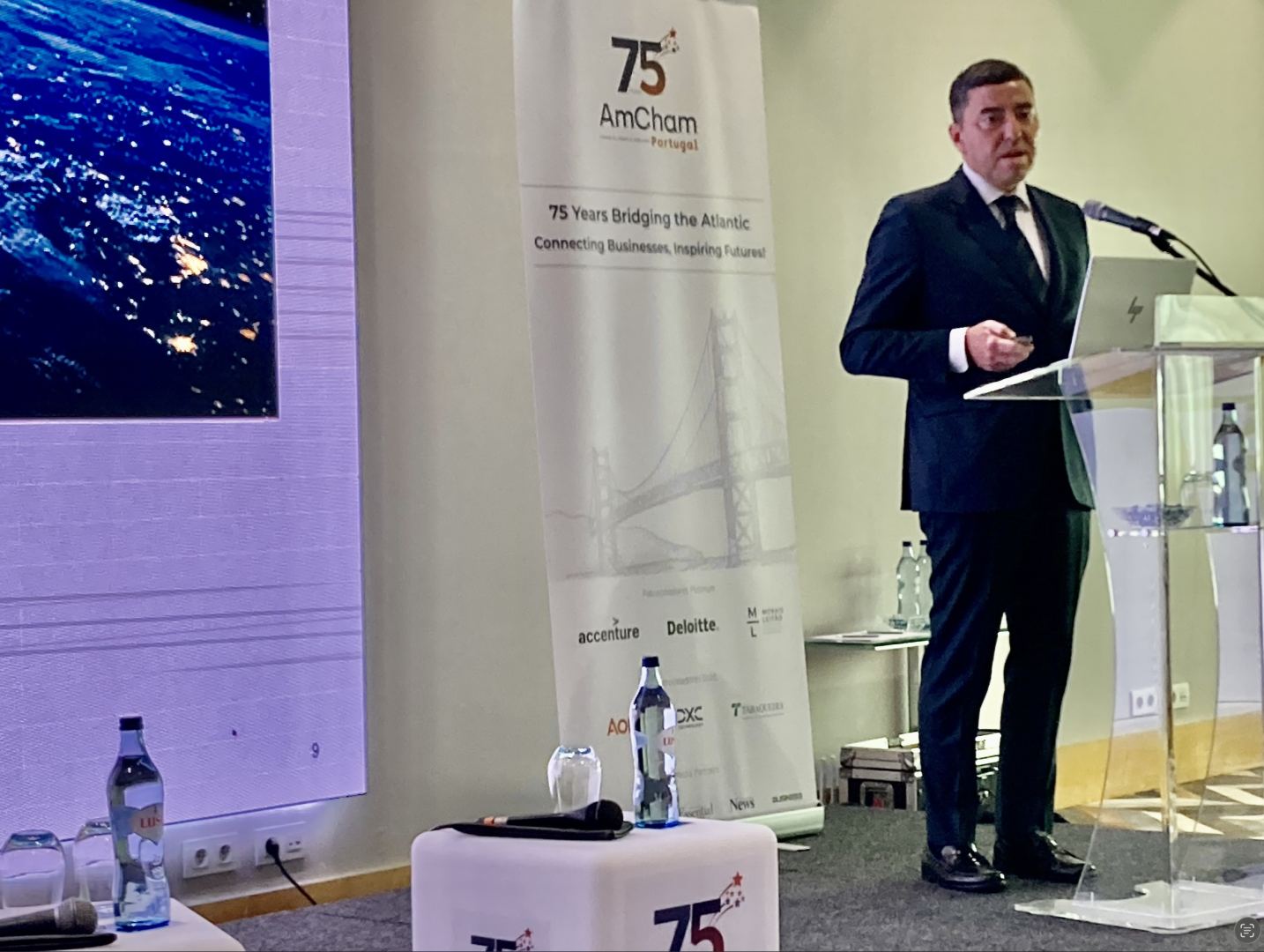
The 3rd barometer and its key findings were presented by José Bizarro Duarte, Partner and Head of Markets at PwC Portugal at the American Chamber of Commerce (AmCham Portugal) conference ‘Portugal in the Sights of International Investment’ held at a Lisbon hotel on Thursday, July 9.
The report is produced annually because in the current international context, marked by profound economic, geopolitical and technological changes, understanding the factors that influence US investment in Portugal and Portuguese investment in the US and competitiveness are becoming increasingly important for business and decision-makers.
Positive conclusions
In his opening remarks preceding the presentation, the President of AmCham Portugal, António Martins da Costa, reminded that AmCham Portugal was celebrating its 75th anniversary at the same time as the United States is celebrating it’s 250th year since the Declaration of Independence from the United Kingdom.
“We can see that the conclusions are frankly positive and that American investment has an important role in Portugal’s economic fabric,” he said.
The numbers speak for themselves: according to Portugal’s overseas export bureau AICEP and its statistical unit INE, the United States is now the third major overseas investor in Portugal.
In terms of Foreign Direct Investment (FDI), the “podium is occupied by Spain (No1) and France (Nº2) and the US (Nº3).
The US has a stock value position at just under €17Bn (€16.8Bn) of direct overseas investment in Portugal.
Moreover, the US is now the fourth major destination of Portuguese exports, overtaking many of Portugal’s traditional partners (like the UK and Germany) in this respect.
Another factor worth highlighting is that the number of US visitors (relocants, vacationers, second-home owners, and businessmen and women to Portugal stood at 2.4 million last year.
“There has been a welcome boom of American interest in Portugal which has had a positive effect”, said Mr. Martins da Costa.
Geopolitical and economic fragmentation
In 20-minute presentation, Mr. Bizarro Duarte, outlined the results from key US companies against a backdrop of a world that is effectively fragmented—and increasingly so.
“We face geopolitical and economic fragmentation, as well as the struggle or even failure of multilateralism across various organisations.
There is a growing difficulty in making multilateralism work, creating a real need for a more detailed, segmented, and fragmented dialogue. This allows individual countries and regions to assert themselves in this new world, navigating challenges such as economic resilience and the difficulty managers face in finding the stability needed to make the best decisions at any given moment”, he said.
This was a world where technology and artificial intelligence were transforming lives and the operations of organisations and companies; indeed, AI and technology were decisive factors for corporate competitiveness.
Naturally, this process must involve people. Significant disruptions in talent management and the labour landscape introduced additional risks—such as social and workplace fragmentation—that managers needed to address.
Energy security
The final area considered was energy security. “We all witnessed the events of early 2022 following Russia’s invasion of Ukraine—specifically the disruption and energy security crisis that Europe experienced.
“We are still dealing with the aftereffects of the resulting blockades; although the events occurred somewhat far away, they naturally impacted everyone—citizens and businesses alike”, said Mr, Bizarro Duarte.
Therefore, the issue of energy security—an area where Portugal has also made significant strides—was a defining theme of our world today.
“It is crucial that we—countries, organisations, companies, and individuals alike—successfully address this context, including the reconfiguration of value chains and the challenges posed by technology and artificial intelligence; indeed, within this reshaping world, this global competition must be viewed by the Portuguese economy as both a priority and an opportunity”, he states.
High level of confidence
The study showed that “the high levels of confidence demonstrated by executives of US companies in Portugal were a clear indication of the maturity of their operations in Portugal and of the potential to further deepen there economic relationship between the two countries.”
To assess the relevance of US companies in the Portuguese economy, the Moody’s Orbis database was researched which had 841 US companies or of American origin operating in Portugal with operating revenues of €150,000 or over.
It was also based on data from Portugal’s National Statistics Institute (INE) which has identified 11,000 overseas companies in Portugal of which 7.6% are of US direct or indirect origin.
This reflects a highly relevant US presence and significant impact on Portugal’s economy and as a country in terms of US investment.
In terms of longevity, taking 2024 as a reference year, 38% of the companies analysed have been operating in Portugal for more than 20 years and 44% for at least five years, demonstrating the maturity of US investment in Portugal.
But there has been a reduction in the number of smaller companies with a turnover of less than €1 million from 37% to 28% for the year.
However, there has been an increase in the number of medium-size companies (10% to 12% for €5-10 million turnovers) and from 18% to 20% for companies between €10-50 million turnovers).
In terms of distribution 70% of US companies are in the Lisbon region, 20% in the Porto region with the remainder spread fairly evenly nationwide.
Tech and Sales 44%
The type of US companies operating in Portugal are dominated by Tech, IT and Communications companies (22%), Wholesale, Retail, and Vehicles (22%), with Professional, Scientific and Technical activities at 15%.
Manufacturing was 12%, Admin and Services (8%), and Real Estate (7%). The weight of US companies on the Portuguese economy has risen from 3.6% in 2022 to 4.8% in 2024 reflecting the expansion of their activities and their increasing role in wealth creation in Portugal.
And US companies spend on average twice as much on staff as other non-US firms paying an average investment of €1,622 per employee while monthly salary costs reached €3,730 per employee in 2024.
US main non-EU export market
The United States stands as the primary destination of Portuguese exports to non-EU markets, accounting for 6% of the total, 32% market, exceeding exports to both China and Brazil.
And within services, tourism from the US plays a particularity relevant role growing 58% between 2021 and 2025.
In 2024, arrivals of US tourists increased by 13.6%, consolidating their position as one of the main long-haul source markets.
Regarding imports, the US accounts for around 2% of Portugal’s non-EU imports, remaining a significant supplier outside of the EU.
The study and report was detailed and comprehensive and this publication does not have the space to list and enumerate all the findings.
Portugal needs to do better!
However, one thing stands out: “Portuguese entities must promote, seek out, make every effort, and create the conditions for American investment in Portugal to accelerate, deepen, and diversify; this is because it has a genuinely positive impact on the Portuguese economy and on the wages people earn, and it will certainly have a positive impact on retaining young people in a country facing the challenges of an aging population and an intensifying demographic shift”, stressed Mr. Bizarro Duarte.
And pointed out that American companies in Portugal pay more than double the average wage of Portuguese workers. Their contribution to GDP has also been growing; today, 5% of GDP is actually derived from American companies, and this upward trend is clearly positive.
And in the final analysis, Portugal continues to demonstrate significant competitive advantages in a world of heightened geopolitical uncertainty, accelerating technological change, and increasing competition for investment.
For the full findings of the repot please consult the AmCham Portugal Website.
Sources: AmCham Portugal/ PcW Portugal