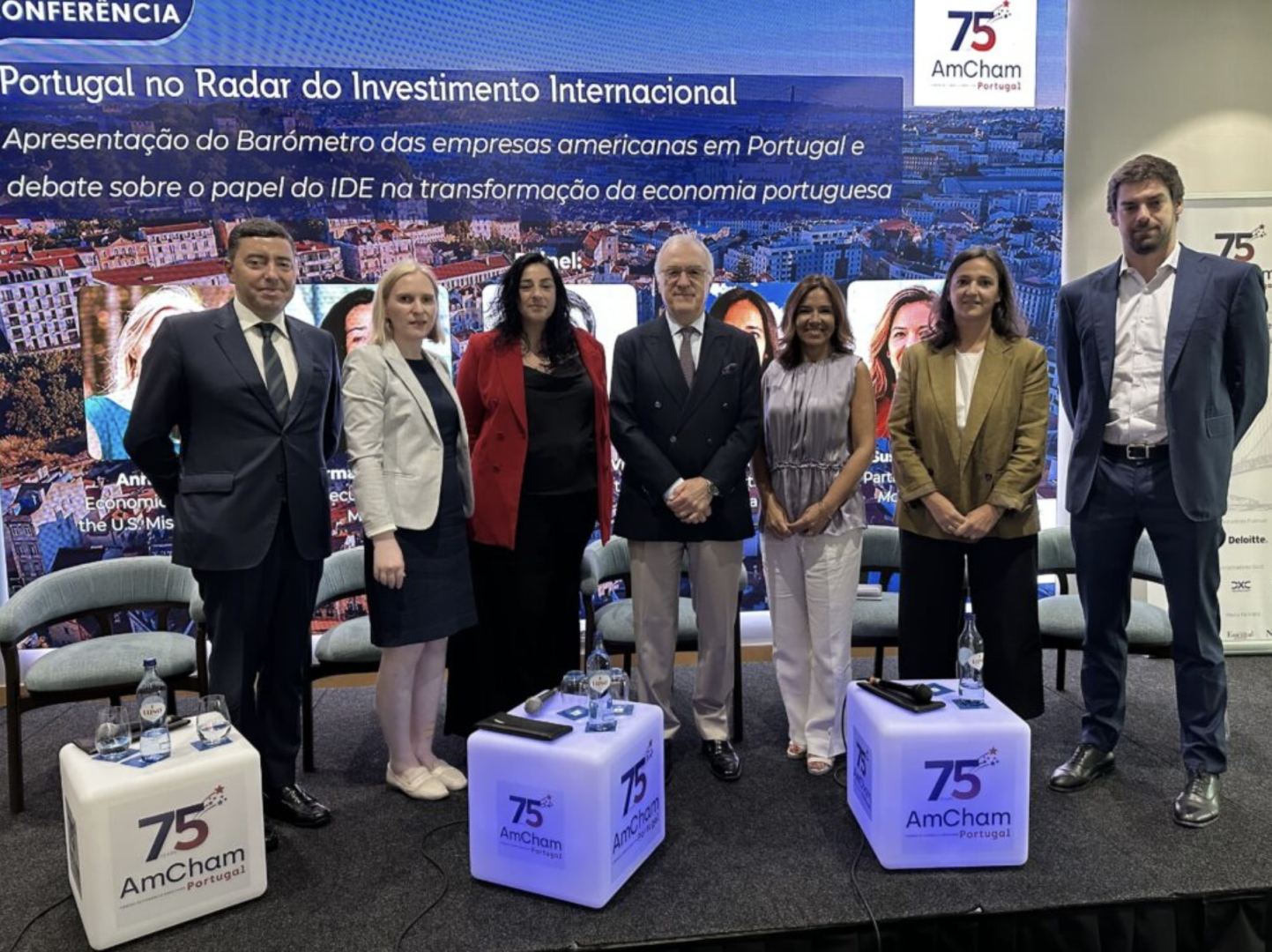



Portugal a great country to relocate, live and invest concludes panel at American Chamber of Commerce conference on US investment in Portugal
The number of US companies investing in Portugal is growing as is the amount of sheer investment – but that could be even higher if Portugal cut red tape and simplified and sped up planning procedures.
That was one of the conclusions from a panel of experts and US company representatives at a recent conference ‘Portugal in the Sights of International Investment – Competitiveness, Attractiveness, and Digital Economy’ at a conference organised by the American Chamber of Commerce in Portugal (AmCham Portugal) in Lisbon on Thursday.
The panel discussion was held under Chatham House rules which means that Essential Business can only report on some of the opinions and discussions made without directly referring quotes to either the speakers or attributing them to any specific companies or entities involved.
However, we can say that there were representatives from Portugal’s overseas trade bureau, AICEP, the US Trade Mission, Portugal, Microsoft, and Blackstone.
The opinion from the US side was that the relationship between the US and Portugal has been strengthening per a report published by PwC into US-Portugal commercial relations by partner José Bizarro.
The idea was that if companies and investors can cut through all the political and geopolitical noise there were more possibilities to grow the relationship.

US companies good employers
It was found that US companies in Portugal were generally good employers, offering higher salaries and benefits, with a high sense of social responsibility.
There were also great possibilities in the secretors such as real estate, particularly the Comporta region, as well as opportunities in the AI, Data Centres and Tech areas for companies like Microsoft, AWS, and NVIDIA.
In fact, all of these companies are heavily invested in the mega data centres project Start Campus near Sines.
Against the backdrop of trends between tourism, real estate, technology and AI, many US companies have back offices in Portugal.
For example. Havi Logistics in Vila Nova da Rainha is not only opening a back office in Portugal, but creating one of their largest corporations that service their operations around the world.
So, Portugal was in the sights of US companies for a wide variety of reasons: the talent, excellent English language skills, geography and the quick time difference – five hours with the East Coast and eight with the West Coast, connectivity and infrastructure, safety, the appeal of the country, and the weather which all amount to an environment where more US companies want to open in Portugal.

US – No.1 source of venture capital in Portugal
The US is also the number one source of foreign venture capital in Portugal, a country which otherwise has a lack of capital, financing, and equity.
Portugal has a clutch of important unicorns such as Talkdesk, Sword Health, OutSystems, Feedzai, Remote, and Tekever to name a few – and all of these unicorns have US funding.
Several of these unicorns have jumped across the ocean and became US companies.
But there’s another side of the story. It’s not just about US investment in Portugal, it’s the robust and growing Portuguese investment in the United States.
Part of this is companies like Portugal’s Orient Teknik – a distributor of generators, water pumps, and technical tools, catering to the needs of projects, industries, and B2B businesses.
They see the United States as a jumping point, not just as a market itself.
And talent continues to attract investors to Portugal even if the level of bureaucracy and regulations scares others away.

The speakers reflected on Portugal’s position in a globally competitive environment hungry for investment at a time when factors such as talent, innovation, stability, celerity in execution (setting up projects and companies) and regulatory and fiscal predictability were increasingly major factors for attraction for investors.
A reduction in red tape, the simplification of licences, and a capacity to accelerate bureaucratic and planning processes continued to be among the main stumbling blocks to investment and company attraction and national competitiveness.
To be fair, it was pointed out that Portugal was making inroads into dealing with a cumbersome and unfit-for-purpose public administration at both central and municipal government levels, including the setting up of an entire ministry dedicated to State reform.
And while planning permission for a charm hotel might take up to six years, as was the case of one overseas hotel group trying to get planning permission for a unit in Lisbon’s Graça, when it came to large-scale, big-ticket investment projects, particularly those of national strategic interest, entities like Portugal’s Ministry of the Economy and AICEP pretty much jump through hoops to get things done and approved.
Then there are Portuguese companies doing well in the US such as electrical and renewables energy giant EDP, drug manufacturers Hovione and Bial, construction and engineering company Infraplus, and automotive firm TMG which has invested in the US.
Other firms include, Sodecia: An automotive supplier that established a strong US footprint, operating multiple manufacturing plants in the US, and The Navigator Company: A major European manufacturer of pulp and paper that maintains a corporate and distribution presence in the US.
And let’s not forget Corticeira Amorim – the world’s largest cork producer, which has a dedicated US subsidiary (Amorim Cork America) based in Napa, California, to serve the wine industry.
One commentator said it was a robust and growing relationship and it was amazing to see how the US could provide seed capital or equity financing that then creates dual citizenship companies that will grow the economic relationship between the United States and Portugal.