


Arbitrary detention in China – two Western victims tell their harrowing stories
Text and Photo: Chris Graeme
We all know countries arbitrarily detain people, particularly autocratic regimes, but it’s one thing being aware of the phenomena, and quite another to hear the experiences and stories of those who actually endured the frightening experience.
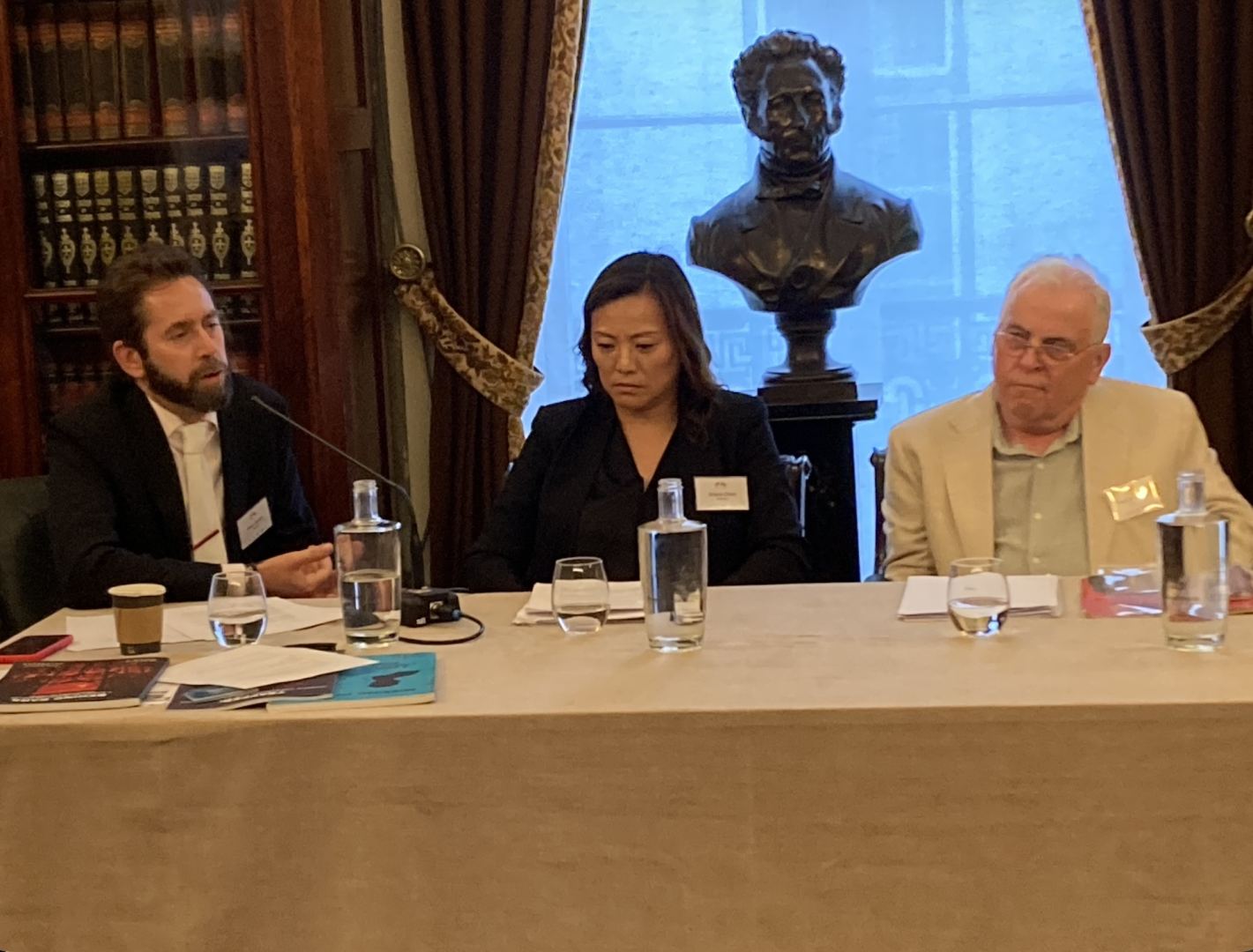
Which is why it was chilling and fascinating to hear the testimonies of a British consultant and Swedish activist who were arrested and imprisoned under China’s Xi Jinping regime, at an event entitled ‘When Borders Don’t Protect: Arbitrary Detention and State-to-State Hostage Taking’ organised by the American Club of Lisbon on Tuesday evening at the Grémio Literário in Lisbon.
Peter Humphrey, a Briton, and at that time an EU citizen, was wrongfully imprisoned in Shanghai along with his American-Chinese wife between 2013-2015 on false charges of illegally acquiring personal information for the use of his due diligence company, ChinaWhys.
The case attracted intense media coverage and they were held for over a year in the Shanghai Detention Centre and for a second year in prisons, on sentences of 2.5 and 2 years respectively.
In captivity Peter, a former journalist, developed cancer and medical treatment was deliberately withheld, and their 18-year-old son was left to fend for himself.
Peter Dahlin, a Swedish activist, who operated a human rights organisation from 2008 and 2015 in Beijing, was detained by the Chinese State Security in January, 2016.
Peter was held in solitary confinement for 23 days in a secret ‘black prison’, part of a new (at that time) system for secret detentions, and accused of ‘endangering state security’ through his work for the China Urgent Action Working Group.
He was interrogated and forced to make a televised confession, as was Peter Humphrey, and was eventually deported in dire physical and mental health after suffering abuse tantamount to torture and being paraded on Chinese television.
Today, he runs a successful NGO from Europe called Safeguard Defenders’ focusing on human rights in China.
Also on the panel was Grace Chen, a former Legal Advisor to the UN Special Rapporteur on Torture, with deep expertise in international human rights law and state accountability.
Even before the debate had begun officials at the Chinese Embassy in Lisbon had put pressure to bear on the American Club of Lisbon asking them to cancel the event.
When that tack failed, they allegedly sent out fake online flyers with a different venue (Sintra) and a different time (9pm) to confuse would-be attendees.
The embassy also requested that should the event go ahead, that a fair and balanced approach be used in both the telling and any subsequent reporting. Essential Business makes no opinions in this piece. It simply tells the stories of these two men who were held in detention in China from their experiences. It also extends an open invitation to the Embassy of China in Lisbon to a right of reply which Essential Business will publish if received.
Peter Humphrey points out that there is no such thing as a free and transparent trial in China and “not a single prisoner in a Chinese jail as have had one.”
“This is why our governments must intervene robustly with Beijing every time one of their citizens is arrested or imprisoned”.
But when I suggest that China has never been a country governed by the rule of law in the Western sense of the word he tells me that is wrong.
“Before 1949 the Chinese government was developing a modern judicial system and had written a modern constitution and had even signed the Universal Declaration of Human Rights.
“But when that government got toppled by the People’s Red Army and the Communist Party took over in China, “that movement towards a modern judicial and constitutional system was halted.”
Peter adds that what China has now is “the worst it has been since Chairman Mao was in power.
“The leaderships who came after Mao were “more liberal” and were liberalising and reforming China and that included China’s approach to judicial matters.
“Xi Ping stopped all that and we’ve actually seen the judicial system regress over the past 12 years,” he says.
Peter points out that Western governments have been “seduced” by China over the past 40 years and sucked into a tremendous dependency on the Chinese economy and the Chinese government.
And adds, worryingly, that many Western governments, including the UK, do “not stand up for their citizens when they are arrested and destined in China because there is too much money involved.
I ask legal beagle Grace Chen what needs to be done to bring pressure to bear on the Chinese authorities?
“Arbitrary detention and state hostage-taking requires multilateral efforts. It requires countries and states to get together and coordinate their efforts. It is still too much of a piecemeal endeavour at the moment, so states need to work together on this.”
And she stresses that the problem of state detentions and hostage taking is not confined to China but other countries too, like Russia and Iran, for example.
“I think we have to focus back on what we believe are the principles we believe in, which is liberty and freedom”, she concludes.
I ask Peter Dahlin, a Swedish national, why he agreed to share his experiences, which involved being held in solitary confinement in a narrow off-blue coloured cell for weeks with no outside stimulation whatsoever, to the American Club of Lisbon?
“Holding such an event doesn’t seem like a particularly big deal, but getting people together who are willing to talk in public about these issues, especially if they are critical of China, in a place like Portugal is incredibly difficult.”
“What happened, of course, is the Chinese Embassy intervened and tried to get the event cancelled and even though we live in a democracy, it’s pretty standard to contact both the venue and organisers to persuade them to cancel such events,” he adds.
Surprisingly, or perhaps not so given the amount of Chinese indirect state sponsored investment made in Portugal over the past 15 years in some key Portuguese companies, including export infrastructures, energy and insurance companies, it often works.
“It failed, so they started an online disinformation campaign over the weekend, putting up fake flyers for the event with different dates, times and locations,” says Peter.
“The issue we’re trying to bring up is not necessarily to step away from China, but we need to be more aware of the risks and these risks have been growing for foreign businesses recently.”
I ask Peter Humphrey and Peter Dahlin about the long-term effects such as post traumatic stress disorder (PTSD) on them both from their experiences under detention in Chinese security facilities.
“Obviously, I was traumatized by what I went through in that system. When I got released, I not only suffered from trauma but also cancer which had been aggravated by a denial of access to medical treatment”, says Peter Humphrey.
“I also had to deal with a case of litigation against the company that placed me in that situation which was a former client that actually led us into this trouble,” he explained.
And emphasises, “you never really leave prison, the experiences never leave you, especially in that kind of environment.”
Peter spent the next five years in and out of counselling for PTSD in the UK with various therapists.
“None of them were really able to help me much and I suffered all kinds of problems with panic attacks, flashbacks and crying all of the time,” he admits.
“It never leaves you when you’ve been through such dark abuse”, he confides as he struggles to keep back tears welling up in his eyes.
Peter Dahlin tells his own story and agrees you’re left with invisible mental scars forever, always looking over your shoulder but feeling safer in each country that is further away from China’s influence.
“The perverse thing was that I actually looked forward to the six hours of interrogation being asked the same questions over and over again for days on end as it was the only thing that broke the unbearable monotony of being in a blank empty cell alone with no stimulation other than your thoughts which in the end became your own worst enemy.
“I constantly worried about putting others who I knew in danger, wondered where my colleagues were and what was happening to them. I said nothing.”
Both continue to assert to this day that they were completely innocent of the charges that were made against them.