


Coastal erosion – why policy makers, planners and developers need to rethink building close to beaches
Text: Chris Graeme; Photos: IPBN
All coastlines, including Portugal’s, are affected by storms and other natural events leading to erosion. But the jury is no longer out and has already pronounced that global warming and coastal tourism development is accelerating this process, creating devastating consequences for local communities.
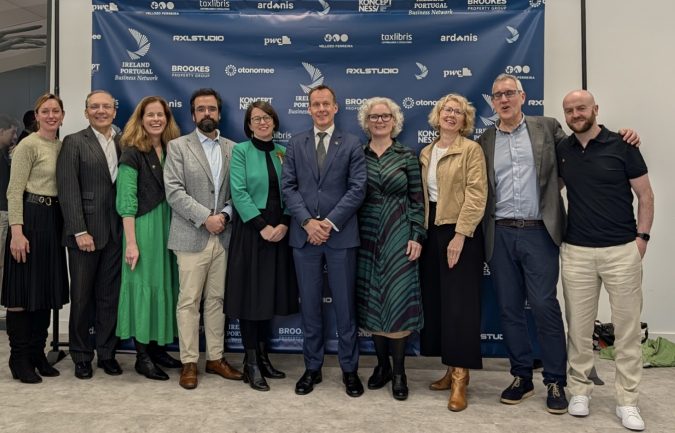
Coastal erosion and policing Marine Protected Areas were among the pressing issues discussed at the 7th Ireland-Portugal Business Network (IPBN) Sustainability Conference which took place at the University Europeia’s Oriente Green Campus in Moscavide on Tuesday, March 17.
This year’s conference theme, ‘Ocean – The Blue Economy,’ reflected the growing urgency and opportunity surrounding ocean sustainability, innovation, and responsible economic development.
With Ireland and Portugal both deeply connected to the Atlantic, the ocean represents not only a shared natural heritage, but also a powerful space for joint leadership in sustainability, science, and technology.
Welcoming the delegates and speakers to the university with which the IPBN has a partnership, the rector, Hélia Gonçalves Pereira, highlighted 17,000 square metres of campus, all totally sustainable and “built from scratch”.
“I’m happy to host this conference because it is important for us as a young Portuguese university (only 12 years old) to host external events, representing 20% of the total innovation developed in Portuguese higher education today,” she said.
The university currently offers 400 bachelors, masters and PhD degrees, and in 2025 had 14,000 students enrolled at all levels of study.
The Chair of the IPBN, Geoffrey Graham (Senior Partner at Edge) said that it was important to focus on the ocean in particular at this year’s Sustainability Conference given the “politicisation of the ocean itself” together with the “frontline effects that extreme weather has been having on coastal regions in Portugal” from the winter storms.
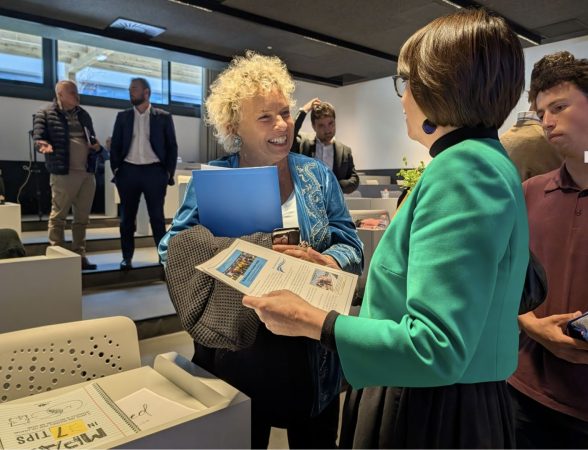
Inovation at the forefront of marine protection
But the focus was also about innovation, extreme weather on costal infrastructure, and tech-driven marine protection and of course financing and funding.
“Innovation really is at the forefront of how we deal with sustainability and climate challenges affecting the ocean itself and coastal regions”, he said.
H.E. Alma Ní Choigligh, Ambassador of Ireland to Portugal, highlighted the many opportunities provided by the university to study subjects of interest and relevance to the sustainability of the oceans and coastal areas, and added that the IPBN “represented something very special about the Ireland-Portugal relationship.”
Mary Butler (TD), Minister of State at the Department of the Taoiseach (Prime Minister’s Council of State) with special responsibility as Government Chief Whip; and the Department of Health with responsibility for Mental Health had planned to attend but had to cancel at the last moment.
However, in a recorded message she conveyed a message of support for the work of the IPBN in fostering increased trade links between Portugal and Ireland. “The work of organisations such as yours is vital in kitting together business communities, nurturing innovation, and creating employment.
“The recent 2025 Tony Boyle Business Success Awards (The awards honour the legacy of James Anthony “Tony” Boyle, IPBN founder and former Chair, whose vision, integrity, and commitment to building bridges between Ireland and Portugal continue to guide the network’s mission) really showcased the network’s growing presence in Portugal,” she said via a video link.
The conference explored the theme ‘Ocean – The Blue Economy’ through a series of engaging panel conversations, bringing together experts from both countries to share real-world experience, research, and forward-looking solutions across three key areas.
The UN Ocean Decade
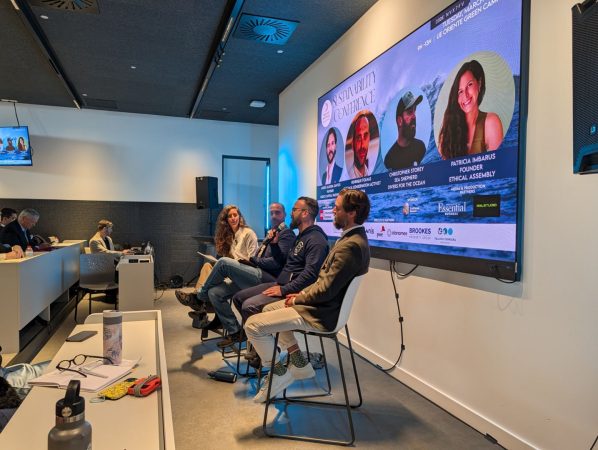
Panel I, featured a chat about about Science-Driven Innovation / Ocean Climate Justice with Christopher Storey from Sea Shepherd – Divers for the Ocean, one of the leading international organisations focused on marine protection, André Almeida Santos, partner at Indico Capital Partners which has created one of the first ocean impact investment funds in Europe, and Henrique Folhas representing Sciaena one of the leading organisations in Portugal focused on the environmental protection of the ocean, and moderated by Patricia Imbarus, founder of Ethical Assembly which run international climate action and social justice summits.
The panel started with the UN/UNESCO led UN Ocean Decade. In 2017, the UN General Assembly declared 2021-2030 the UN Decade of Ocean Science for Sustainable Development .
This ‘Ocean Decade’ aims to achieve seven societal outcomes: A clean ocean where sources of pollution are identified and removed, a healthy and resilient ocean, a productive ocean, a predicated ocean, a safe ocean, an accessible ocean and an inspiring and engaging ocean.
What came out of the conversation was the troubling fact that over 80% of the ocean is still effectively unprotected and a collaboration across civil society, policymakers, investors, researchers, academia and innovators was needed to close the gap.
“I think one of the achievements of these first five years was the agreement on the BBNJ – the ICES Treaty”. This is an agreement under the United Nations Convention on the Law of the Sea on the Conservation and Sustainable Use of Marine Biological Diversity of Areas beyond National Jurisdiction (BBNJ).
“The oceans cover two-thirds or 50% of our planet and (this agreement) sets a precedent, and I think this has been the main achievement of the last five years”, said Henrique Folhas (Sciaena).
Lack of enforcement for MPAs
Christopher Storey highlighted more ocean transparency, satellites, data and innovation as pluses but, on the negative side, there was no solid enforcement for Marine Protected Areas (MPAs).
“It’s great having legislation and talking about protecting areas, but following up with marine enforcement, maritime police and navies is still not well acted upon,” he said.
“That’s where Sea Shepherd comes in; we work with governments in West Africa and the Pacific Islands, helping them with crew and ships since they don’t have the capacity to do that, but obviously it is positive that we are talking more and raising awareness about what is happening in the ocean and why we need to protect these areas,” he said.
On the investment side, André Almeida Santos (Indico) said that thanks to an explosion of data and knowledge there is now a much broader understanding to create, restore and protect Marine Protected Areas with sustainable business models.
However, there was a lack of operational models with the capacity to make use of data in an organised, structured and sustainable manner.
“We are lacking business models that are regenerative and at the same time profitable and scaleable, and these are still to come, so there’s a lot of work, but I’m optimistic”, he said.
Indico has the Indico Blue Fund, a climate action fund for the Blue Economy covering all blue verticals (excluding extractives), with tickets from €100,000 to €5 million for companies that can make measurable contributions towards Sustainable Development Goals (SDGs).
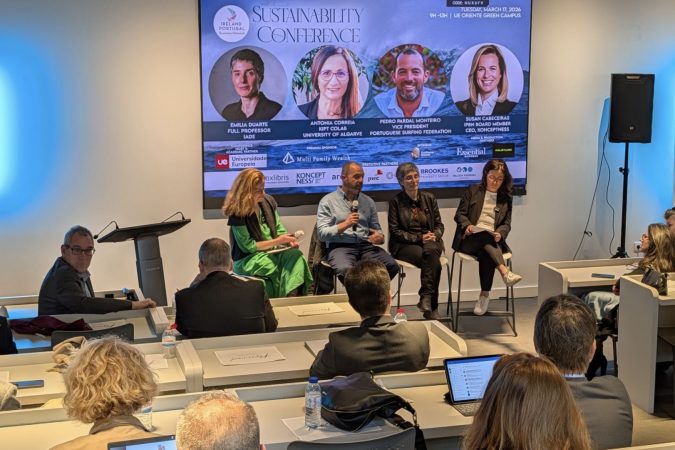
The second panel was a lively conversation about the often terrible real-time climate impacts on coastal infrastructure with Professor Emilia Duarte – UE/IADE – “Diving Heritage: Design Innovation for Resilient Coastal Communities through Underwater Cultural Heritage Tourism”, Antonia Correia, KiPT COLAB, CODE Blue Project, and Pedro Pardal Monteiro, Vice-President of the Portuguese Surfing Federation | Surf Project Manager | Surf Coastal Engineering Expert. The panel was moderated by IPBN Board Member Susan Cabeceiras, Founder & Chair KONCEPTNESS Gestão de Projetos, Imobiliária, Arquitetura, Engenharia & Design.
The devastating effects of coastal erosion
Coastlines and coastal regions, and Portugal’s are exception, are increasingly in the frontline of climate change, and one has other think twice before building close to the ocean as it all carries an impact and cost for the environment.
Pedro Pardal Monteiro, as a surfer who works in the surfing leisure sector, said that the first noticeable was coastal erosion and the consequences of rising sea levels.
The second noticeable issue was extreme weather events (Suffered at first hand by Portugal with the back-to-back series of storms that lashed the coast in January and February).
“These weather events are more frequent and intense with each passing year, and we had a lot of storms this winter which we don’t usually have, and the effects were devastating with a lot of erosion for out beaches,” he lamented.
And added: “These phenomena don’t exist on their own; they are nature’s reaction to the interventions that we as human beings have been doing to our coasts, and we as surfers were raising red flags to politicians about building along coastlines 25 years ago and the damage it was doing. It might be good for business and the economy, but it’s destroying waves,” he regretted.
And the Portuguese Surfing Federation has been trying to defend the waves and the coastline with a clear message not to build so close to the coastline.
Changing worldviews and mindsets
Emilía Duarte (UE/IADE) admitted “we feel fragile and frustrated because the planet is out home and we feel attacked and our lives put at risk because often the planet has different plans to our own.
“We need to change the way we look at the planet and accept we cannot change nature and do whatever we like, like build our homes in a coastal area. We assume that nature, the sea and coast are there for our enjoyment and do whatever we like. We don’t own it and we need to change our worldview and mindset.”
Antonia Correia, KiPT COLAB, discussing costal erosion and shoreline retreat, pointed out that more sand was being brought to the beaches in the Algarve to counter erosion. “It’s not a good idea to build close to the coastline, and we are going to get a lot more coastal erosion and we have to be prepared for that.”
The second problem was damage to local marine ecosystems that actually protect the coastline from erosion.
The third issue was human pressure on coastlines because of tourism and because tourists want to be close to the beach. “Building puts a lot of pressure and vulnerability to the ecosystem. We need to raise awareness and cooperate because when we build close to the sea it has a big environmental impact.”
The third and final panel ‘What’s Next? The Future of Tech-Driven Marine Protection’ featured Lee Bristow, The Ocean and AI – Tech Driven Protections, Agostinho da Silva, Catolica Porto Business school – Board Member, MARE, Marine and Environmental Sciences Centre, Pedro Costa from the University of Coimbra, with the panel moderated by IPBN Board Member Mario Gago, CEO Pink Room Software. Essential Business will report on the this final panel next week.