



Make your peace with God and fly!
Text: Chris Graeme
I remember going to see the film ‘Top Gun’ back in 1986 with some university pals in Colchester, UK.
It was not because I was really that interested in military matters (ironically my first job would be a discharge clerk at a military prison!), but rather because I was overwhelmingly outvoted by the other guys against the sci-fi thriller Aliens, which was what I really wanted to see.
But I went anyway because they wanted to see it. Besides, at that time I was a weekend DJ and all anyone could ask me to spin (vinyl 45s back then) was the hit title song from the film soundtrack ‘Take My Breath Away’ by Berlin.
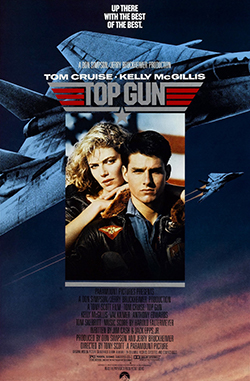
Reality of Film Fantasy?
Ok, I was entertained. But just how accurate was the film? ‘Top Gun’ and its sequel ‘Top Gun Maverick’ (2022) are generally considered to be 60-70% accurate, combining real naval aviation equipment and intense, practical in-cockpit flying scenes with rather exaggerated plots involving equally distorted pilot egos.
In any case, that, I thought, was the end of it, until I received an e-mail invite from the President of the American Club of Lisbon, Patrick Siegler-Lathrop to hear the story of a real TOPGUN in the US Navy and was curious to see where facts ended and fiction began.
Interestingly enough, that same year, on another continent across the ‘pond’ in a tiny town called Weber Falls in rural Oklahoma, a teenager called Edward Chandler also went to see the film and it changed his life. He came out of that theatre and decided he wanted to be a real TOPGUN and that’s exactly what he set out to do and achieve over a career spanning 32 years.
So, Ed Chandler, having spent three years living in Portugal, had finally having taken the plunge to move lock, stock and barrel to Cascais with his wife and family, entertained the members of the American Club to a talk about what it was really like being a real TOPGUN.
His talk, backed up by slides, entitled ‘Danger Close – Leadership at the Edge’ held at the Grémio Literário in Lisbon was inspiring, interesting, if at times at little technical.
Instead of focusing on the recent rescue of a US naval pilot in Iran, costing the US armed forces a purported US$300 million – his talk did start with the US Embassy Hostage Crisis in Iran in 1979* for some background, but it swiftly moved to how he became a ‘Stalker’.
In the context of the US military, ‘Stalker’ generally refers to two distinct entities: the 160th Special Operations Aviation Regiment (Night Stalkers) (Army elite helicopter unit supporting Navy SEALs) or the I-Stalker (AN/SAY-3) (Navy shipboard sensor system). They are renowned for specialised night operations, rapid deployment, and advanced surveillance capabilities.
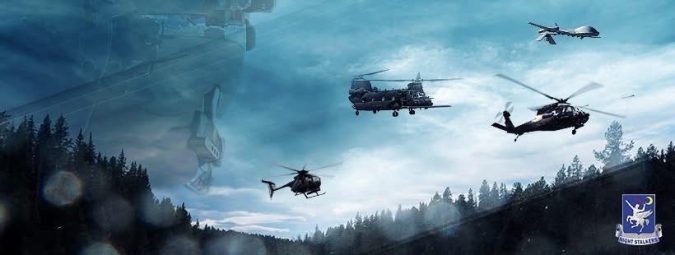
Starting off in helicopters
And Ed Chandler flew us through about what it takes to train to become a TOPGUN and a ‘Stalker’ and what it is like to live and operate in one of the most dangerous operating environments in the world – a US Navy aircraft carrier.
For a start, the initial pilot training including having to get yourself out of a submerged helicopter cockpit (blindfold) would be enough to put most people off, I imagine. And just to get an idea of how dangerous missions can be, pilots are told to make their peace with God before every mission.
Oh, and if you hit the water at speed for any miscalculation or pilot error, it’s curtains for you. No chance of survival in this high stakes profession.
A kid in a candy store
Now a retired US Navy commander, formal naval aviator and currently an executive leadership advisor, Ed Chandler recalled his teenage years by saying “So in 1986, when the movie “Top Gun” came out, it was the greatest recruiting effort ever for the United States Navy, and I was like a kid in a candy store”.
He attended the Naval Academy (not like a normal university), and learnt about “legend and legacy” in naval service and about heroes like Horatio Nelson, and graduated as an ensign in the Navy.
And you have to know a lot: aviation physics, meteorology, and water survival trials before learning to train how to fly a small jet aircraft called the Cessna Tweet.
“That’s where we learned the basics. To take the airplane off, how to recover from a stall, be able to fly from point A to point B in regular weather, and then land the airplane”.
If you survive basic flight training, then the trainee pilots choose their future path. Either helicopters, jets, or maritime patrol.
“I obviously stayed in jets, and I went off to fly the T-2 in Meridian, Mississippi. The T-2 was a slightly bigger airplane, although the engines weren’t that much bigger, but it was more maneuverable and a little bit faster”, Ed recalls.
He and his fellow trainee pilots almost died once in a thunderstorm and torrential downpour and were forced to land “all over the place” in Meridian, Mississippi.
Advanced training started on a T-45 Goshawk (500km/h) and learning to drop bombs accurately from 15-20,000 feet.
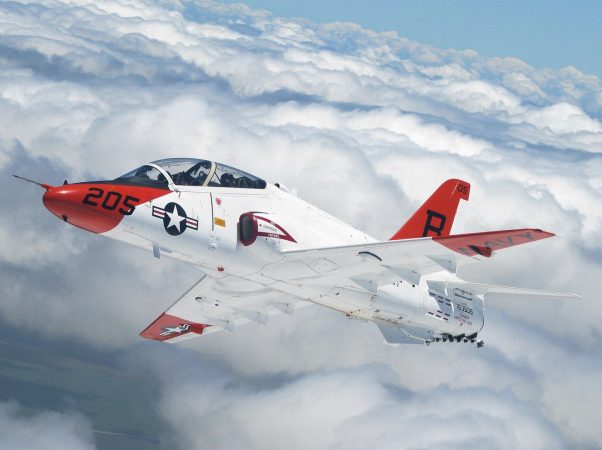
Image: A T-45A Goshawk executes a turning rejoin during a recent formation flight over South Texas. The T-45 is a twin-seat, single-engine jet trainer and is the only aircraft in the Navy’s inventory used specifically for training pilots to land aboard aircraft carriers.
From there it was learning to land on a aircraft carrier. “Everybody thinks landing on an aircraft carrier is really hard, but it’s not. There are three things you have to manage. You have to manage right slope, lineup, and angle of attack. And that’s it”. (Don’t even ask!)
Landing means catching a hook point which catches a wire and slows an aircraft from 240km/h to zero in two seconds!
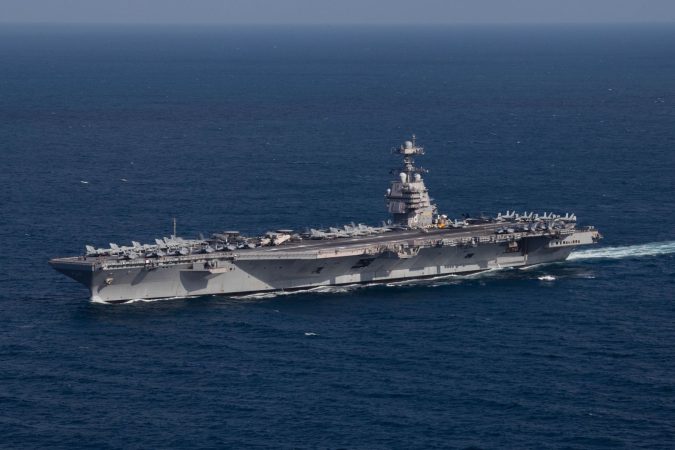
Image: The U.S. Navy aircraft carrier USS Gerald R. Ford (CVN-78) steams the Atlantic Ocean during a simulated straits transit with the Gerald R. FordCarrier Strike Group (GRFCSG) in the Atlantic Ocean, 9 October 2022. The Gerald R. Ford Carrier Strike Group was deployed in the Atlantic Ocean, conducting training and operations alongside NATO allies and partners since 5 October 2022. On deck are aircraft of Carrier Air Wing (CVW-8). – This image was released by the United States Navy.
The landing area on a carrier like the USS Gerald R. Ford, the US Navy’s newest aircraft carrier, is under 330 meters long.
During World War II landing correctly gave a pilot a 50/50 chance of surviving a career as a naval aviator; today thanks to angled decks things go wrong in less than 1 case out of every 100,000 flying hours.
“We are graded on every single landing that we do on the carrier and all those grades are posted including the names of the evaluators,” added Ed.
F-14 – a beast of an airplane
To begin his journey to becoming a fully-qualified TOPGUN pilot Ed joined VF-101, a fleet replacement squadron where new F14 Tomcat pilots are taught at Naval Air Station Oceana, the Navy’s master jet base in Virginia Beach, Virginia.
“The first thing you notice when you get there is these things are huge. This is a beast of an airplane. It is literally twice the size of that little T-45 that I just qualified on the carrier. In fact, at 19.1 meters long and 11.6 meters wide when the wings are back, a tennis court makes for a really good parking spot.”
Now it’s this kind of training you glimpse in the film Top Gun. Now it’s the serious stuff. Flying sorties and landing at night.
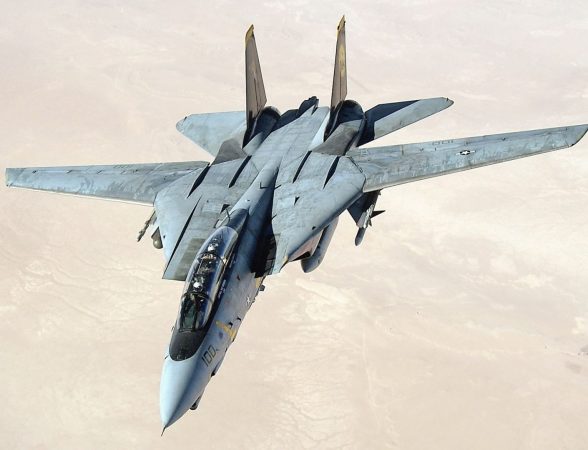
Image: Persian Gulf (Nov. 5, 2005) – An F-14D Tomcat, assigned to the “Tomcatters” of Fighter Squadron Three One (VF-31), conducts a mission over the Persian Gulf-region. VF-31 is assigned to Carrier Air Wing Eight (CVW-8), currently embarked aboard the Nimitz-class aircraft carrier USS Theodore Roosevelt (CVN 71). U.S. Air Force photo by Tech. Sgt. Rob Tabor (RELEASED)
U.S. Navy photo – This image was released by the United States Navy.
VF-32 – a squadron with a long tradition
He joined the VF-32 Swordsmen Striker Fighter squadron to learn how to fly the F-14B upgraded variant of the Tomcat.
Founded in 1945, VF-32 squadron strikers were the first Navy pilots to fly strikes against the Japanese homeland in World War II.
It fought in the Korean War in the Cold War and was the first to fly Cougars, Crusaders and F-14A Tomcats. It flew in the Gulf of Sidra Action in 1986, being the squadron and two of its Tomcats that downed two Libyan MiG-23 fighters during that incident.
It flew in Desert Storm, Bosnia, Operation Southern Watch, Operation Desert Fox. 1998, it was the first F-14 to deliver laser-guided bombs. All this before Ed had even “set foot in the squadron”.
And it is only when a squadron pilot reaches level 4, leading four airplanes or commanding combat missions that you finally become a TOP GUN.
It was as a fully qualified Top Gun that he began his first major deployment in 2002/3 aboard the USS Harry S. Truman (CVN 75), the Nimitz-class, nuclear-powered US Navy aircraft carrier commissioned in 1998.
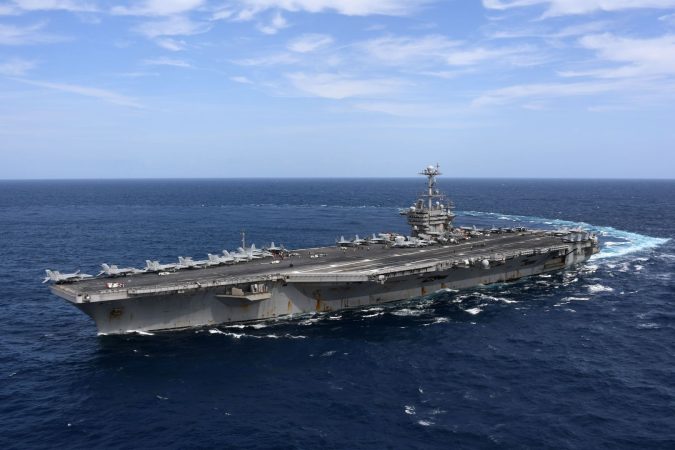
Image: Autor: MC2 Thomas Gooley, Credit: U.S. Navy
The 2nd Iraq War
In the Eastern Mediterranean, “our air wing commander calls us all into the ready room and he says, “The decision’s been made. We’re going to be attacking Iraq.”
This was the start of Operation Iraqi Freedom (2,200 US deaths). “He told us to look to our left, look to our right at the other men and women, our brothers and sisters that were in the ready room with us.
And he told us, “The operation is going to be called ‘Shock and Awe’. We are going into the heart of Baghdad, the most heavily defended piece of dirt on the entire planet. And the expectation is that one in three of you is not going to come home. So go back to your staterooms, write your letters home, make peace with God, and then let’s get back to work.”
And that’s the kind of bravery you have to have to be a real TOPGUN. Knowing that one in three will get shot down and die.
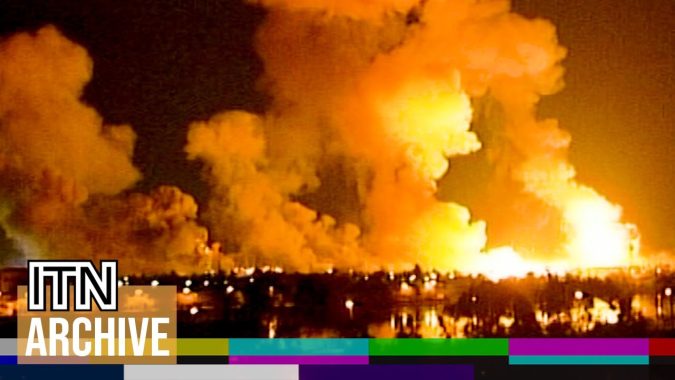
Still Image: Operation ‘Shock and Awe’ 2003 ITN Archive
I asked him if he was scared at the thought of death when he went out on active missions. “If you’re the kind of person who gets scared, that’s found out pretty soon after initial training in the airforce and you leave then and there.
“I got launched over and over again. I’d come back, I’d sleep for a couple of hours, I’d jump in an airplane, and they would send me right back in.”
For four days he did that, never knowing what the outcome was. At the end of that deployment he had done 1,000 hours in a Tomcat and would never fly that model of aircraft again.
“That was out for me. I came away with a pretty good evaluation and some interesting experience”, Ed said about the Iraq War.
“I was now heading off to Naval Air Station Fallon, the home of the Naval Air Warfare Center Weapons Division (NAWC) and TOPGUN, in the middle of the Nevada Desert.
So yes, TOPGUN is real. It’s an actual place. There’s an actual school called TOPGUN. It’s not just a movie.
And Ed Chandler concluded where the story began:
“You’d be surprised how many people don’t know that it exists. Now, you’ll hear us refer to “Top Gun the movie” or “TOPGUN.” (One word all caps).
The reason? Because Top Gun became so popular in the 1980s that the Navy had to trademark it!
Notes:
*Iranian students stormed the US Embassy in Tehran, taking 52 Americans hostage for 444 days to protest against the US allowing the deposed Shah, Mohammad Reza Pahlavi, into the US for cancer treatment. The crisis solidified anti-American sentiment in Iran, doomed Jimmy Carter’s reelection, and lasted until January 20, 1981, when hostages were released upon Ronald Reagan’s inauguration).
Of course, that 1979 military rescue mission Operation Eagle Claw was aborted after two helicopters suffered mechanical failures en-route, and a third was found unfit to continue to the rendezvous site in the Iranian desert. It was the beginning of the end for President Jimmy Carter.