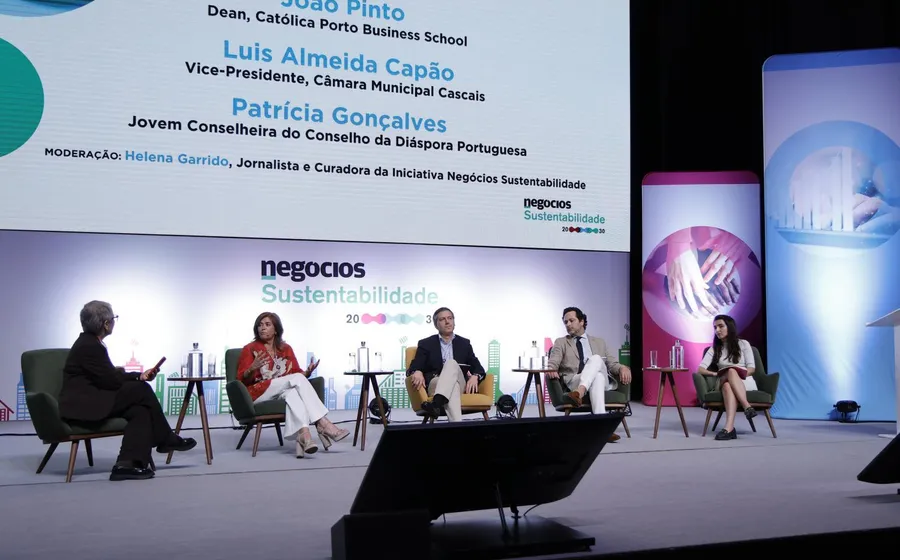



IA and robotisation needs data, regulations and new competencies
Businesses, schools, and local authorities are already feeling the impact of technology such as AI, but adapting requires literacy and critical thinking found the Negócios Great Sustainability Business Conference in Carcavelos on Thursday.
The time when artificial intelligence promised transformation for organisations has long gone, participants in the debate “How can we adapt to AI and robotics?”, moderated by journalist Helena Garrido at the ‘Great Sustainability Business Conference‘, confirmed that the big question today is how society can use these tools without losing knowledge and critical thinking.
At Sociedade Ponto Verde, CEO Ana Trigo Morais explained that this path began even before the recent acceleration of AI. “We started in 2022 and 2023 thinking about what could change,” she stated. The organisation had to “allocate resources and thinking” and “reorient” its role in the value chain, calling for “new ways to solve problems.”
In the recycling sector, technology can help improve processes, from geo-referencing to information management. “There’s a fundamental issue, which is data. Without good data, it’s not possible,” warned Ana Trigo Morais, reminding us that it’s necessary to invest “in a public policy to achieve excellent data capture.”
Also in higher education, adaptation is no longer optional, and academia has been forced to absorb technological advancements. For the dean of Católica Porto Business School, João Pinto, this sector has “a very important role in the up-skilling and re-skilling” required by AI.
At the university, a strategy was created in 2024 based on the idea that technology “is here” and “will create disruptions,” with the goal of showing students and teachers that these tools should serve “to complement their critical thinking.”
The strategy includes literacy, teacher training, and clear rules, with a code of conduct for everyone. “A student writes their dissertation using ChatGPT, then the teacher evaluates it with ChatGPT, and at the end of the day, where is the knowledge?” he pointed out, fearing a “knowledge collapse.”
In local government, the Deputy Mayor of Cascais. Luís Almeida Capão sees AI as an opportunity to increase productivity and free teams from routine, repetitive, and low-value-added tasks. “It’s an enormous capacity that local authorities gain to increase productivity,” he argued. Luís Capão recalled that, in the last two decades, municipalities have made “a tremendous leap” in their ability to work with quality data and that this path should continue.
This evolution now allows the application of AI models to areas such as licensing, he exemplified, recalling that in Cascais the automation of process entry began in 2011, allowing “the technician to only evaluate what really needed to be evaluated”. On the other hand, the mayor believes that AI could also help compensate for the difficulties in hiring in the public sector, at a time when much talent “is fleeing to the private sector”.
Patrícia Gonçalves, from Diáspora Jovem – Tecnologia e Inovação, focused mainly on the impact of AI and robotisation on employment, recalling that although there are advantages in the tools, the risks should not be underestimated. “The CEO of Microsoft says that AI is like a bicycle, a scaffold for human knowledge, and a year later he lays off 15,000 workers,” she exemplified.
Younger people, she says, could become “masters” in the creation and management of AI agents, adding an ethical dimension to the process. In industry, however, robotisation continues to face limitations, and in factory tasks with greater detail and nuance, “we are not getting the desired results.”
Technology could take on tasks that are “more arduous for the body and mind” and have a positive impact, for example, on applied research into diseases. The essential thing, he argued, is to use these tools “not to replace my reasoning, but to complement it.”
Source: Negócios; Credits: Negócios