


Portugal’s general strike – a success of damp squib?
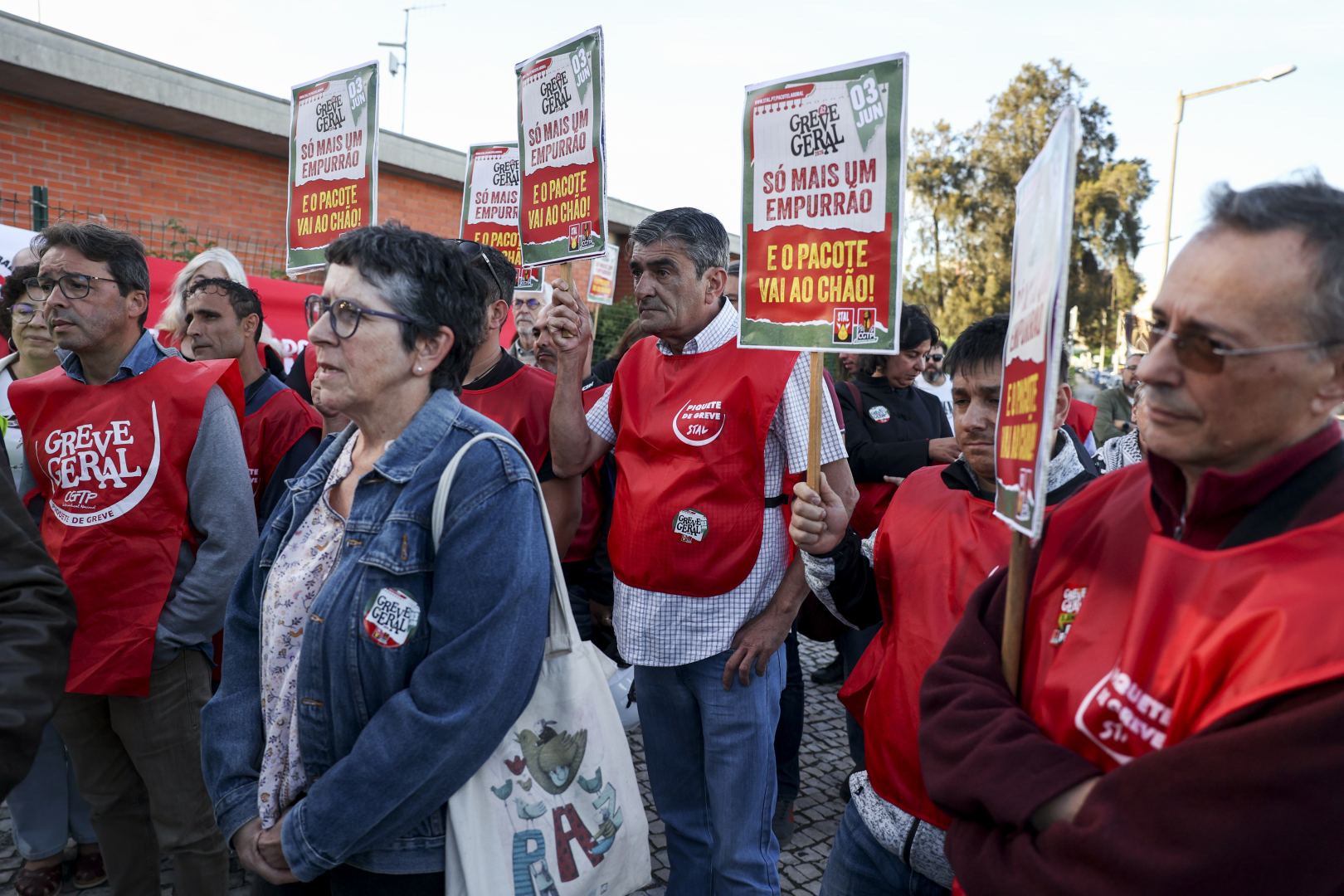
One of Portugal’s largest unions, the CGTP-IN has estimated that the one-day general strike on Wednesday enjoyed significant adherence in several sectors with hundreds of work places at a standstill or with high rates of adherence.
But that’s not how either the government or business and industrial associations see it. They say the strike was a failure, and most of the country turned up to work.
The sectors that unions say were affected included industry, transport, local government, health and education. However, its affirmation contrasted strongly with estimates from both the government and business associations which inferred it was a damp squib.
According to information compiled by CGTP-IN/DIF up to 6:00 PM, multiple companies and services are reporting “production halted,” “closed,” or with participation rates of 100%, 95%, 90%, 80%, and 70%, indicating a widespread impact from the strike. Examples include manufacturing plants, waste management companies, municipalities, public transport, healthcare facilities, and schools across various regions of the country.
The list shows a strong impact on industry, with cases of production stoppages in companies such as Exide Technologies, Bosch, APTIV, Visteon, Forvia Faurecia, and other units linked to the automotive and metalworking sectors.
In local government, there are numerous references to closed or fully adhered-to waste collection, urban cleaning, workshops, construction sites, municipal transport services. In education, several schools, kindergartens, and school districts are reported closed.
In healthcare, the CGTP (General Confederation of Portuguese Workers) reports high levels of participation in hospitals and local health units, including operating rooms, consultations, emergency rooms, wards, and support services, with several cases exceeding 70% and some reaching 100%.
In transport, there are references to operators and structures such as Carris, Lisbon Metro, TCB, Transdev, Busway, Rede Expressos, and rail services, also with strong participation or minimum services.
In his speech, Tiago Oliveira, Secretary-General of CGTP-IN, said that “workers, from north to south of the country, are holding a major General Strike. This is because we are facing one of the most serious attacks on workers’ rights in recent decades. A labour package that the Government intends to push forward and which represents a profound setback in labour relations.”
But one of Portugal’s largest business associations, the Portuguese Business Confederation (CIP) retorted that the general strike had less adherence than the last major strike which took place on December 11 last year.
The Portuguese Business Confederation (CIP) states that companies from various economic sectors reported minimal participation in the strike, with levels falling below the impact felt on December 11.
“According to the available and confirmed data, this general strike passed by the vast majority of Portuguese companies,” assures the CIP, quoted in a statement. “What our members have conveyed to us are zero or insignificant strike levels, generally limited to workers with union activism.”
The business association states that the different sectors of economic activity, including the chemical, metalworking, textile, footwear, wood, furniture, automotive, large-scale distribution, and pharmaceutical industries, “practically did not register any participation in the general strike anywhere in the country.”
“In the electrical and electronic and agro-industrial sectors, in the units where there was a higher number of striking workers, participation was between 2 and 3%,” notes the association led by Armindo Monteiro.
Update – strike adherents residual
By Friday (June 5) more figures on the strike adherence had come to light with the Minister of Labour and Social Security Maria do Rosario Palma Ramalho trumpeting: “There wasn’t a single factory closed”.
The minister added that the strike had had a “residual effect” but that the full extent of numbers would not be known until next week.
The energy company, EDP, one of the largest companies in Portugal said only 3% of its workforce chose to strike.
In trade and services some 5% went on strike and all shopping malls remained open. In healthcare there was close to 0% adherence in private hospitals while in public hospitals 25% of routine and 72% of scheduled operations went ahead, although adherence among doctors, nurses and other medical staff the figure was higher at between 70% and 90% depending on regions and specific hospitals.
The country’s ambulance services were largely unaffected with only 1.6% striking. When it came to public transport the Metro was closed and other public transport services operated a reduced service with 49% of staff choosing to strike.
All of the country’s ports remained open and worked normally except the Port of Setúbal where 88% of workers went on strike.
In the hotels sector the percentage of adherents was close to 0% while banks, construction, and agriculture also saw 0%.
Some 23% of public sector workers went on strike which rose to between 38% and 45% of schools depending on the region.
However, one area that was affected were the country’s airports with over half of flights cancelled in Lisbon and over 40% at Porto, Faro, Madeira and Ponta Delgada airports according to the airports management company ANA.
Of the 1,472 flights scheduled across the country on Wednesday, 658 had were cancelled, according to information provided by ANA. This number represents 45% of the total movements planned at Portuguese airports on the day of the general strike.
Lisbon has the highest percentage of cancelled departures and arrivals. Of the 658 flights scheduled for Lisbon airport, 408 were cancelled, equivalent to 62%.
The second highest percentage of cancelled flights was in Ponta Delgada, where 41% of the 118 scheduled flights did not take off on Tuesday, according to information provided by ANA, updated at 10:00 AM on Wednesday.
In Porto and Faro, nearly a third of all flights did not take place. At Francisco Sá Carneiro Airport, 108 of the 335 scheduled flights were cancelled, equivalent to 32% of the total. In Gago Coutinho, 69 of the 228 scheduled flights on Wednesday did not take place, equivalent to 30%.
And the effects of the strike continued to be felt on Thursday, particularly in the transport, rail and air travel sectors.
CP, Portugal’s rail company reported constraints on Thursday as it operated minimum train services.
As for companies, some were more affected than others with industrial companies such as Sovena, Cimpor (100%), Bosch (95%) and Galvidro (88% most affected.
Portugal’s Prime Minister, Luís Montenegro addressed the nation yesterday evening stating that the “overwhelming majority of the Portuguese had chosen to go to work.
But in an interview with State broadcaster RTP on Wednesday, The general secretary of the CGTP (General Confederation of Portuguese Workers) said that the majority of Portuguese people “do not identify with the labour package”.
Confrontations with police – strikers or extremist troublemakers?
Throughout the day television channels broadcast images of confrontations with the police both in front of the Portuguese Parliament building and São Bento close to the Prime Minister’s residence yet only 6 arrests were made and the police said that those involved were “extremists” and had nothing to to with the strike. Virtually all of the demonstrations up and down the country passed off peacefully.
The strike was called by unions after they failed to reach an agreement over the current Democratic Alliance government’s package of labour reforms which they claim severely reduces workers’ rights.
The package aims to create more flexible workforces, contracts and hours which the government says are necessary to make the country more competitive and productive, and align with a raft of modernisation policies such as digitalization, big data, robotics, artificial intelligence, and the streamlining and efficiency of public administration.
But the unions claim it’s a highroad to exploitative employment practices, a gig-economy and redundancies in a country where average salaries still stand at between €1000-€1,200 per month.
For example, in the country’s hotel sector, which employs up to 350,00 and represents 9% of the workforce, it is not unusual for employees to persistently work at weekends and be called in to work on days off, making the work-family balance often intolerable, and retail, catering and hospitality are almost as bad.
The proposed overhaul of Portugal’s labour legislation, also known as “Trabalho XXI”. Put forward by the PSD/CDS-PP coalition government, aims to bring more than 100 changes to the Labour Code.
The package was negotiated within Portugal’s social concertation framework, but the government led by Luís Montenegro ultimately failed to reach an agreement with the social partners, prompting the CGTP to submit notice for the previously announced strike.
The confederation argues that the changes amount to an “assault on workers’ rights” and an “affront to the Constitution of the Portuguese Republic”.
Nevertheless, the labour reform bill has been approved by the Council of Ministers and presented by the government as “a structural revision of labour legislation to boost productivity, improve wages and adapt the labour market to the challenges of the digital economy”.
The bill has already been submitted to the Assembly of the Republic, and July18 has been set for a general debate and vote.
Sources: Negócios, CIP; ECO, Jornal Ecónomico, CNN Portugal & RTP; Credits: Lusa. MIGUEL A. LOPES/LUSA
Copyright: © 2026 LUSA – Agência de Notícias de Portugal, S.A.