


Portugal resilient despite string of crises but must do better says central governor
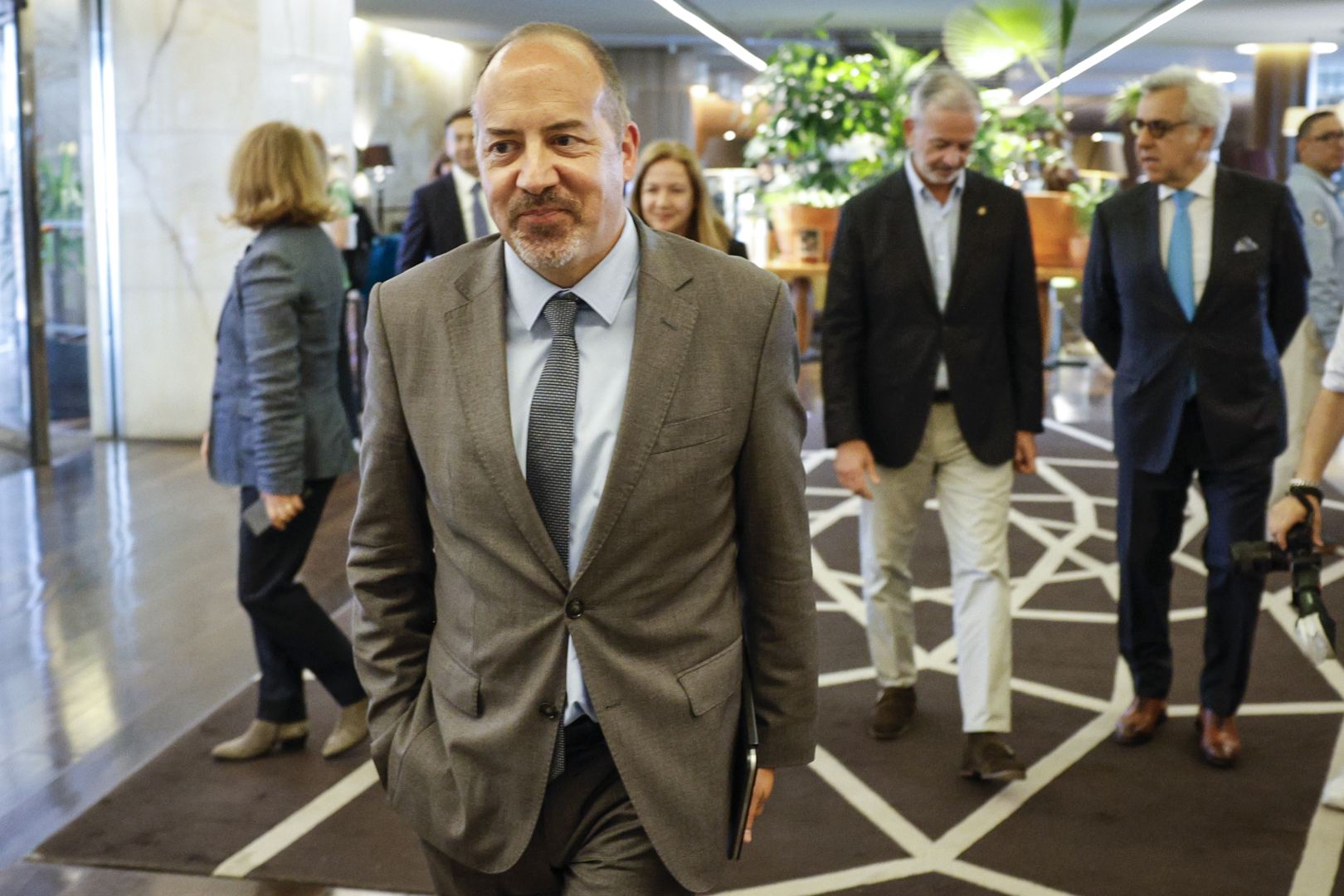
Since joining the euro in 1999 Portugal’s economy has grown at only around 1% per annum while it’s companies have relied heavily on European Union handouts. With growth currently at 2% and productivity lagging behind its member-state partners, Portugal has a long way to go as it tackles considerable geopolitical cross winds says the Governor of the Bank of Portugal, Álvaro Santos Pereira.
Text: Chris Graeme, Photo: António Pedro Santos/LUSA
It was a sombre, if honest, appraisal of Portugal’s economic performance over the past few years from Portugal’s central bank governor, Álvaro Santos Pereira who outlined a fistful of internal and overseas challenges on Monday.
However, the governor, hotfoot from the Spring Meetings at the International Monetary Fund in Washington late last week, gave credit where credit was due.
Portugal was seriously tackling its national debt, weaning itself off an over-reliance on imported energy, made some inroads on State reforms, and had geared its economy towards greater exportation.
But it was a bit like a potentially talented pupil being dragged off to the school principal’s office after getting mediocre grades only to be given a “must do better” in his school report to be taken home to anxious parents.
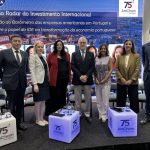
Álvaro Santos Pereira, who was Portugal’s minister of the Economy between 2011 and 2013, had come to address the American Chamber Of Commerce (AmCham Portugal) on the geopolitical situation and its impacts on the markets and the Portuguese and European economy at Lisbon’s Sheraton Hotel & Spa.
Despite cheery smiles and a warm approachability, once in front of the microphone he took on the air of a sober and straight-talking, almost 19th century statesman, donning the mantle, it seemed, of the deceased economist Henrique Medina Carreira who had a habit of giving the pure, unvarnished truth to anyone would listen to him.
The governor also discussed the huge upheavals affecting businesses and society, including digital transformation and artificial intelligence and their ramifications for Europe, the United States of America and the rest of the world.
The international economy, he said, was enduring the fourth major shock since 2020. The first had been the pandemic, the second had been inflation which had begun to rise following the Russian invasion of Ukraine and which had led to the worst energy crisis since the 1970’s.
This had been followed by the tariffs imposed by the Donald Trump administration and the most recent shock was the wars in the Middle East, culminating in the closure of the Strait of Hormuz and the blockade of Iranian ports.
All of these had raised levels of uncertainty and increased instability in the oil and natural gas markets with significant price fluctuations, volatility in the financial and raw materials markets, but it was the effect on the gas markets that were most concerning for Europe for the forthcoming summer and winter.
The disruptions on helium, for example, which is fundamental for the manufacture of the semi-conductors vital for artificial intelligence, was particularly worrying for the governor since 40-50% comes from that region.
This volatility regarding raw materials was reflected in the currency exchange and stock markets and for ordinary citizens at the petrol pumps.
There was a big increases in petroleum prices and although it was hoped that these would diminish in the futures markets, all was contingent on the length of the war and whether it got worse or not.
“Obviously, when there are wars, often there are unexpected actions that could have an unexpected impact on the conflict itself and on the price of raw materials and oil”, he said.
“What worries me is the issue of natural gas, not for Portugal, but mainly for Europe since natural gas is absolutely fundamental” he added, although prices had not risen as high as had been the case with the Russian invasion of Ukraine.
Nevertheless, the increases were “fairly significant” particularly regarding levels of natural gas storage in Europe which were close to the low levels seen in 2022, and were more serious for Germany which would be disastrous in the advent of a cold winter (Storage levels are currently at 20%) if disruptions were to continue.
“This will have repercussions in many industries, it will have a huge impact on electricity prices, and if there are even more disruptions in the Strait of Hormuz or if, for example, the conflict worsens and parts of Qatar or other facilities are hit again, we could have a serious medium-to long-term problem”, warned Álvaro Santos Pereira.
According to the Bank of Portugal’s forecasts, the geopolitical situation could result in an increase in inflation and a reduction in growth.
At present, the increase in inflation stands at 2.8% for this year while growth is estimated at 1.8%.
The drivers of Portugal’s economy
The governor remarked that tourism had fallen slightly, although the conflict in the Middle East could help counter as tourists who may have been thinking of holidaying in places like Dubai might choose Portugal as a safer destination.
“It is important to say that domestic demand, mainly consumption and to some extent investment, especially public investment related to the PRR (Recovery and Resilience Plan), are the main drivers of the economy, especially consumption”.
“The part that concerns us most at the Bank of Portugal has to do with exports. There was a loss of market share for Portuguese exports last year, both within Europe and outside Europe. It’s something we’re still trying to understand why. We know that part of the Sines refinery was closed, there were one or two constraints at the service level, but we will carry out a more detailed analysis and in June we will present those results,” he confirmed.
And explained that one of the roles of the Bank of Portugal was to provide a public service, publish data to facilitate public debate and assist in the decisions that needed to be taken.
Falling exports
Regarding exports, the central bank is concerned because while around 2010 Portugal exported 28% of its GDP, at the moment the country is exporting around 45% of its GDP.
“If we start to lose market share, that could be quite worrying for us, especially since we still export very little for the size of our country”, he said.
Belgium and Holland, for example, that have between 10-15 million inhabitants, usually export between 70-90% of their GDP and Hungary also exports more than Portugal.
“We are still exporting far less than we should be exporting. We have improved a lot, but there is still a long way to go”, remarked Álvaro Santos Pereira.
And 40-45% of Portugal’s products were exposed to competition from China and there had been an increase in the competitiveness of these Chinese exports and this posed difficulties for countries like Portugal and Italy.
Reducing Portugal’s debt – “we’ve learnt our lesson”
One of the major transformations that had taken place in the Portuguese economy in the last decade and a half was the shift from very high indebtedness, both in terms of external debt and external deficits, to surpluses.
“We believe that these external surpluses (0.7% of GDP in 2025 and 0.6% in 2024) should likely continue to increase in 2026, based on the baseline scenario.
“We know that the indebtedness of the Portuguese economy reached historic levels during the international crisis and, especially, during the crisis from 2010 to 2014. The indebtedness of the national economy has decreased considerably. We can see that this is happening at the level of individuals, companies, and public administrations”, the governor added.
Therefore, there had been a general reduction in debt among economic agents (banks and companies), although there was a slight increase among individuals last year. “We sincerely hope that this will be reversed as soon as possible. But the most important thing is that when we have lower debt levels we can invest more, which gives us room to maneuver, obviously, and a more resilient economy to shocks than if we have very high debt rates”, he added.
When asked how Portugal had managed to reduce its national debt, (almost to 90% of GDP) his answer is: “We’ve learnt our lesson”.
If the scenario worsens, it may be slightly different, but this improvement in the external surplus is partly due to transfers from the European Union, which are at historic levels because of the Recovery and Resilience Plan (PPR), and therefore this issue may somewhat influence the evolution of the external surplus itself”, he warned.
The Middle East and Cyberthreats
According to the governor, the main risks to Portugal’s economy were a deterioration in the Middle East, a broadening of trade tensions that were still fairly contained, while a low uptake of PPR funds would, in the short term, condition economic growth.
On a positive note, the governor mentioned the implementation of the RRP (if it is greater), spending on infrastructure that would help economic growth, and the impact of new technologies on productivity. (28% below the European average)
Cybersecurity was another issue – a risk that was one of the core themes discussed at last weeks IMF Spring Meetings in Washington in which the governor took part; namely risks that have been detected from the new artificial intelligence models which could put companies at risk.
Another was private credit, namely “some opacity” in the United States which was “concerning” because of the impacts and disruptions in the financial markets and which could spread to the rest of the economy.
“This is something that worries us a lot. We sometimes don’t know the exposure of banks to non-banks, and therefore this issue is of great concern to international organisations and central banks.
Obviously, if we had a scenario where the oil shock was greater that would be of concern – we’re currently seeing a 10% increase in the price of oil and this is tiny compared to what could happen”, he said.
Portugal more resilient
On the positive side, Portugal was more resilient than it had been during previous economic shocks and was less energy dependent, although close to the European average.
Renewables had significantly increased in Portugal, reducing the impact of the oil shock. Even so, natural gas and oil still accounted for well over 50% of Portugal’s energy sources, and therefore vulnerability still existed, which was why energy transition was so important.
The Governor of the Bank of Portugal, in his wrap-up on the Portuguese economy, said that the economy was in relatively good shape and should continue to grow at 2%, which while not “excellent”, was “relatively good”.
This growth was thanks to tourism, consumer purchases, immigration, and an increase in employment in Portugal, but had little to do with productivity.
“For the past 20 years, since we joined the euro, we’ve been growing at around 1%. One percent means it will take us 70 years to double people’s per capita income and 70 years means that nobody will see any change, and their children won’t see any perceptible change either”, Álvaro Santos Pereira lamented.