



AED Days showcases Portugal’s growing importance in defence and space technology
Just a decade ago Portugal was an interested observer on the sidelines of Europe’s and America’s defence technology industry advances..
Not any more. Things have changed with the NATO country having developed a small but growing Aeronautics, Space, and Defence Cluster (AED) with some surprising innovations.
So much so that it devoted three entire days to cutting-edge technology produced by Portugal’s technology companies where projects and high tech were on display at points in Cascais, Estoril and Oeiras outside Lisbon at AED Days held on Wednesday, Thursday, and Friday. (May 27, 28 and 29)
Portugal’s AED Cluster today involves around 160 Portuguese and multinational companies with country offices in Portugal working with these three interlinked sectors, creating synergies in multiple industrial, research and engineering domains.
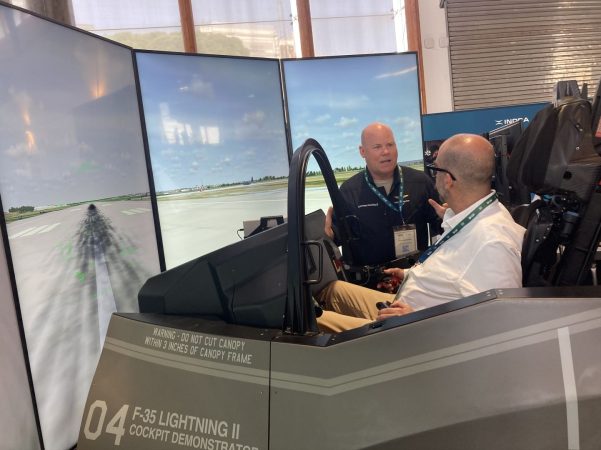
It was a message hammered home by José Neves, the president of the AED who opened a series of talks and panel discussions at the Estoril Congress Centre on Wednesday afternoon where Adam’s Eurojet and Lockheed Martin F32 jet simulators were on display for visitors to get to grips with some of the most advanced aircraft technology in defence today.
Portugal – relevant player in aerospace and defence
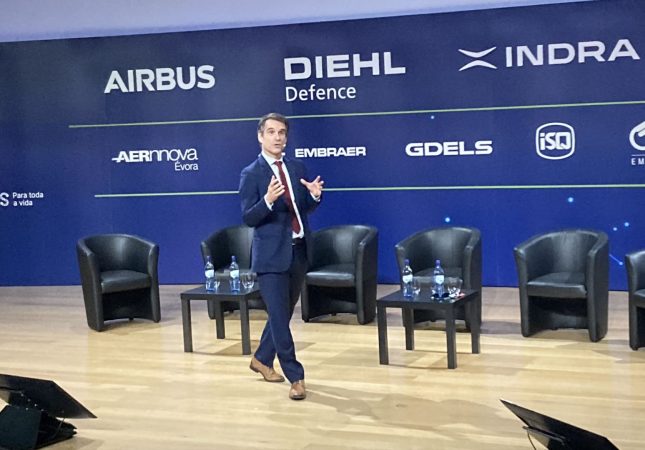
Welcoming sector players to the 13th edition of AED Days, Mr. Neves (pictured) explained how the cluster had created a close partnership with the Oeiras and Cascais municipalities to leverage the aerospace and defence domains and bring more economic and industrial value to the boroughs.
Mr. Neves also pointed out that Portugal was becoming a “very relevant player within the aerospace domain” and here you need look no further than the Portuguese company Tekever whose director of Strategic Development Pedro Petiz took part in a panel at the event – Tekever is now already developing high-tech defence drones in the UK while they are also being deployed in Ukraine.
Tekever’s AI-enabled unmanned aerial systems (UAS) have been actively used by Ukrainian forces in its war against Russia, utilizing their AR3 and AR5 drone models for long-range intelligence, surveillance, and reconnaissance (ISR) missions since 2022.
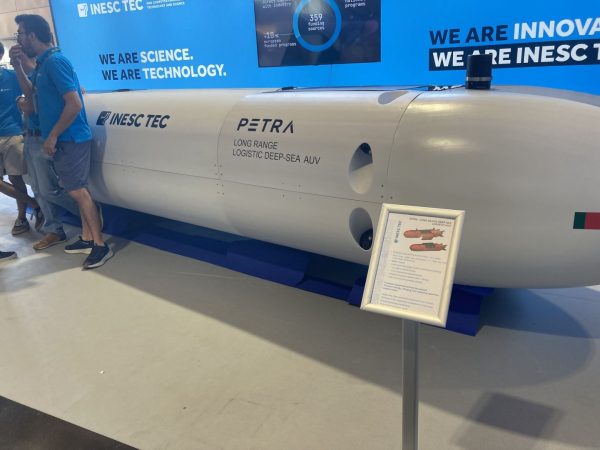
And in the realm of maritime robotics, INESC TEC’s new submarine-shaped robot PETRA (Long-Range Deep-Sea Logistic AUV)) was on display. This vehicle promises to revolutionise deep sea logistics operations with a capacity to descend 6,000 metres. It has a power autonomy to remain on the seabed for several weeks at a time with its first mission set for 2027.
At this edition the AED also launched the first edition of a series of informal talks or Space Square Dialogues to showcase what space projects Portugal has been involved in, with an emphasis on the series of satellites that Portugal has launched in the past two months.
And of course, what event highlighting some of the biggest names in the defence industries today would have been complete without a round of B2B networking meetings.
“It’s really interesting to see that what began as a small national event, even up to to six years ago, has now become a relevant regional event at a Southern European level for the aeronautics, space and defence community, getting together with people who travelled from abroad”, he said.
Portugal’s aeronautics, space and defence sector now has around 190 or more companies and entities all generating around €1Bn in turnover from the sector with these numbers expected to grow by between 10-15% by the end of 2026.
“I would like to say that our focus is really on expats because the internal market is quite small so in order for these companies to survive they have to project themselves overseas,” said Mr. Neves.
In the aeronautics domain Portugal has been reinforcing the work done by Portuguese companies in industry and Maintenance, Repair and Overhaul (MRO) and aerostructures which is sold and growing.
And over the past year the sector has also been developing in new areas such as intelligent infrastructures, new materials and digital software which is now being onboarded in real aircraft.
“Today, Portugal is no longer just a destination for subcontracting, but its companies are increasingly becoming suppliers and Original Equipment Manufacturers (OEMs).
“At the same time, our universities and institutes are progressing with graduates getting more degrees in the aerospace domain”, he said giving the example of the development by Aero Next Portugal of the LUS 222 aircraft – a light regional aircraft developed to serve the needs of civil and defence aviation markets, as an efficient, affordable and sustainable solution particularly in Africa and Latin America with a capacity of up to 19 passengers – which is being developed by CeiiA involving 20 members of the AED cluster.
Investment opportunities for Cascais
Alexandre Faria, President of Cascais Dinâmica a municipal entity whose main focus is to promote economic development, tourism and entrepreneurship in the region, as well as to manage strategic infrastructure (including congress and event venues), noted: “In these times of profound global transformation and the redefinition of properties, where structural challenges are accelerating, sectors such as aeronautics, space and defence play an absolutely essential role in the sovereignty, security, and competitiveness of nations and AED Days provides a meeting point between knowledge, industry, innovation and political vision.
“Above all, it provides the essential ability to build bridges between regions, countries, companies and universities, between research and the market, and between the present and the future that we must build together.”
Cascais, he said, believed in this vision which had materialised in a very concrete way through the strategic development of Cascais Municipal Airport which is managed by Cascais Dinâmica.
“The consistent and significant recent investments in this airport is highly ambitious and we can already speak of a true hub for economic, technological and scientific development,” he added.
In his keynote presentation “Before us, the flood: Geopolitical consequences of the current succession of international crises”, SIC commentator and geopolitical analyst, Nuno Rogeiro discussing the current impasse between Iran and the US reminded that Iran had said: “If the Gulf States attack us from their American bases Dubai will disappear and they will return to the Stone Age”.
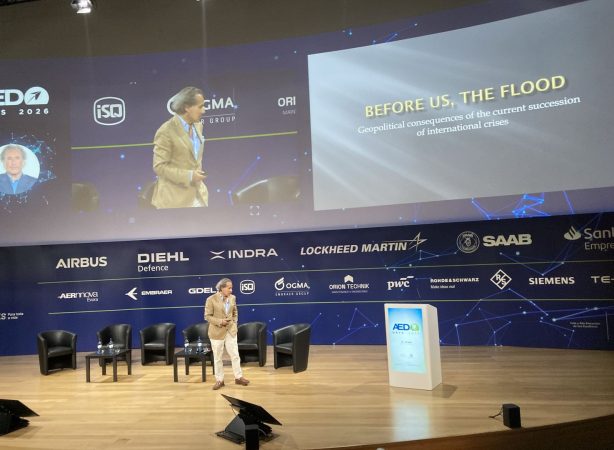
The analyst also commented that in the post-Ukraine war world, (if it was not vanquished by Russia) would become the biggest military power in Europe in terms of manpower and certain technologies.
In any case, Mr. Rogeiro believed the various wars had consequences for security firms, insurance players, banking, business, new technologies, hospitality and, of course, commercial aviation.”
Marco Borghi, Manager of Novaspace, a global leader in space consulting and market intelligence with 10 offices around the world and 40 years of experience, explained that the space sector was radically different from that of the 70s, 80s and 90s.
“It has become more diverse, more private, more agile, and of course extremely strategically relevant ands critical,” he said.
“In general, space is, despite the competition that is present everywhere and throughout the value chain and every sector, nevertheless very collaborative, so deepening engagement in European programmes and expanding international partnerships are key gateways towards the role that Portugal is looking to guarantee for itself in the common space sector”, Mr. Borghi concluded.
Battle ready by 2030?
Rainer Bernnat, Senior Partner, Strategy& – a global strategy consulting business unit of PwC (PricewaterhouseCoopers) which advises corporate, government, and private equity clients on major organisational challenges like growth, market entry, digital transformation, mergers and acquisitions (M&A), and operational improvements, said that the geo-economy was the new geopolitics and Europe needed to learn how to handle and manage trade, technology, finance and armaments as the new strategic weapons and how to apply them.
The strategist said that global crises were “happening at the same time and pretty much interdependent”, which made them difficult to manage.
Mr. Bernnat advanced that it would probably take Europe 10-15 years to get back its sovereignty (meaning not relying on the US for defence) regarding the great powers with China and the US at the forefront and the newer up and coming powers.
And for European defence in a world where experts talked about needing to be “war ready” by 2029 or 2030 as the potential predicted deadline for a full-scale war in Europe, there was a transatlantic strategic realignment with a substantial paradigm shift to what NATO could be in the future.
“We need to advance much further in order to get our strategic autonomy and sovereignty back. Prioritisation is mandatory, that’s pretty clear, because we cannot follow all objectives at once. We need to prioritise and critical technologies, commodities, energy supply, and defence are most critical and need to be given most priority and the window to do so is pretty small”, he warned as the ever-increasing spectre of war in Europe loomed large.
Source: Essential Business