



Portugal – an AED launchpad: from investment to value-upgrading and internationalisation
Portugal may be a small country with a €320Bn GDP, yet in just 20 years its Aeronautics, Space, and Defence (AED) sector has grown from next to nothing to €1Bn in turnover. How has it achieved this, and which are the companies that have helped take the country to a position of prominence in the sector in Europe? Essential Business attended to AED Days in Cascais and discovered how.
Text: Chris Graeme; Photos: AED.
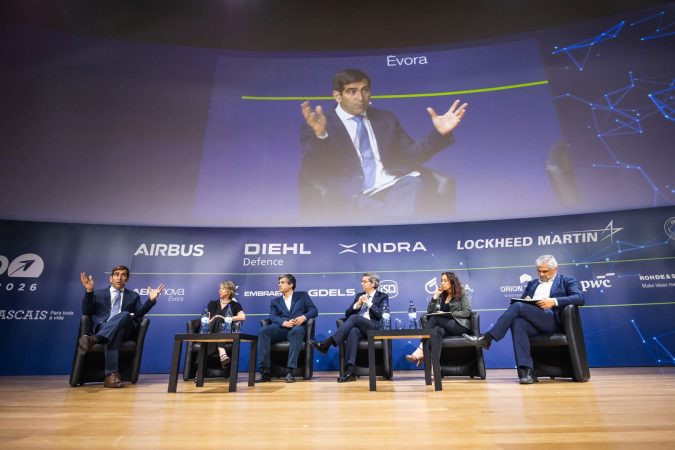
Introducing a panel of cutting-edge Portuguese and multinational companies working directly or indirectly with Portugal’s AED cluster, moderator, José Rui Marcelino, Vice-President of AED Cluster Portugal (Aeronautics, Space, and Defence), a non-profit association that unites over 160 companies, research institutes, and universities across Portugal to grow and internationalise the nation’s capabilities, revealed that two decades ago there were only half a dozen companies in Portugal working in the defence, aeronautics and space sectors while there was a non-existent supply chain.
“We didn’t talk about a Portuguese industry for defence at that time, it was not even addressed but today its addressed on almost a daily basis”, he said.
“As for the space industry, it was almost a dream” although Portugal did have the PROSSE programme, managed by the Portuguese Space Agency (Portugal Space) – a funding programme backing national participation in the European Space Agency’s (ESA) PRODEX.
The programme allocates significant budgets (e.g., up to €600,000 annually, with up to €300,000 per project) to fund scientific experiments in microgravity, terrestrial analogues, and suborbital/orbital missions.
Its past winning projects include brain-computer interfaces (NEURONAUT) and astronaut muscle-loss mitigation projects (ASTROPOWER).
Yet today, at least two Portuguese companies that had started off as startups in the wider sector, Critical Software and Tekever, are now international companies known worldwide.
Paulo Monginho, CEO, OGMA – (Indústria Aeronáutica de Portugal S.A.) – a major Portuguese aerospace and defence company specialising in aircraft maintenance, repair, and overhaul (MRO), and aerostructures manufacturing, and as an Original Equipment Manufacturer (OEM) – has created a joint venture with the AED Cluster.
OGMA, based in Alverca, and the aircraft manufacturer Embraer – the world’s third-largest civil aircraft manufacturer – have joined forces in a successful collaboration and strategic partnership where the Brazilian manufacturer holds a 65% majority stake while the Portuguese State holds 35%.
This collaboration forms a cornerstone of Europe’s aerospace and defence industry, functioning as a primary manufacturing, maintenance, and logistics hub for Embraer’s fleet.
For example, OGMA plays a vital role in the production of the C-390 Millennium military transport aircraft, manufacturing the central fuselage, sponsons, and depth rudders. They are also engaged in the manufacturing of the A-29 Super Tucano to meet NATO standards.
OGMA also acts as an Authorised Embraer Service Centre, providing comprehensive maintenance, repair, and modernisation (MRO) services for the C-390 Millennium, the A-29 Super Tucano, and legacy Embraer ISR aircraft.
“When thinking about OGMA as a company, it really is a miracle. Founded in 1918, it is one of the oldest companies in Portugal and much older than our main shareholder Embraer,” he remarked.
€1Bn in revenues
Mr. Monginho explained how the company, in which both Embraer and Airbus have shareholdings, has enjoyed a huge evolution regarding customers and stakeholders. “Today, it’s amazing to see a company like OGMA with a strategic plan that in three years has brought in revenues of €1Bn”.
“We see that it’s possible to grow in Portugal, not only with Portuguese people with a huge focus on training and staff retention, but also programmes that allow us to be in this marketplace with such big players like Airbus, Lockheed Martin, and Pratt & Whitney among others”, he added.
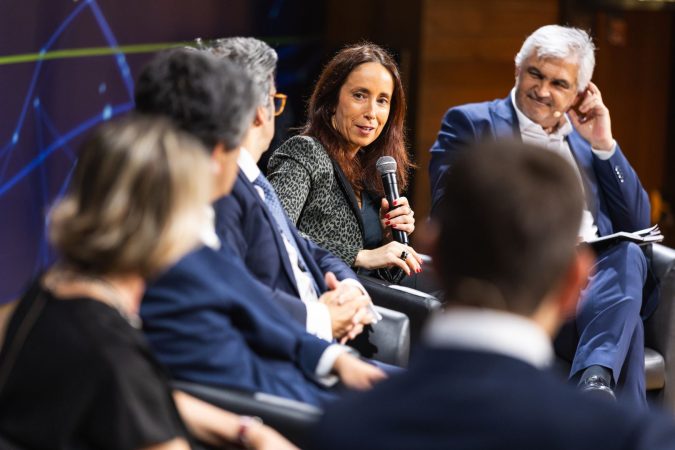
Siemens Portugal – Sixth largest Siemens technology area worldwide
Sofia Tenreiro is the CEO of Siemens Portugal, which primarily produces electric vehicle (EV) chargers and low-and medium-voltage electrical panels at their specialised manufacturing plant in Corroios. Additionally, the company operates major global tech and shared services.
Although Siemens does not manufacture hardware in the AED sector in Portugal, the company does primarily invest in digital engineering, advanced software solutions, and high-tech R&D hubs that equip local partners and foreign contractors to operate in these fields and in smart engineering, logistics and infrastructures also connected with the aeronautic industry.
Siemens, she said, has been in Portugal since 1905 while its factory in Corroios has been in operation since 1995.
“Siemens Portugal is the sixth biggest technological area in the world which is incredible for a small country, coming after the US, China, Germany, India and Austria,” she said.
For example, Siemens has its Siemens Tech Hub (primarily known as the Lisbon Tech Hub); a massive international IT and engineering competence centre. Launched in 2014, it has grown into one of the company’s largest global technology hubs, employing over 1,600 specialists who develop advanced digital solutions used by Siemens worldwide.
“I think that’s exactly because of the ecosystem here in Portugal. More than 10 years ago our headquarters decided to invest in Portugal, leveraging from our location, our geopolitical situation, our talent, and leveraging from all of the incredible conditions that we have here. That’s why Siemens started the Portugal Tech Hub, developing digital solutions for the world”, the CEO explained.
What this meant, she said, was that digital solutions were being incorporated “in our ways of work and our tools that we use every day to become more efficient and an even more technological company ourselves, but also in digital solutions that then are incorporated in our customers and that help our customers to address their problems, needs and opportunities”.
The second element was that Siemens Portugal had managed to also attract investment for a shared service, serving 60 Siemens subsidiaries across the world from Portugal.
“Using our automation, electrification, and cybersecurity expertise, we are continuing to help develop this state-of-the-art AED industry because we know that defence capability is something in which countries are working and investing on and it’s critical, unfortunately”, Sofia Tenreiro added referring to growing multiple threats from hostile countries.
Airbus – creating synergies with a Portuguese tech giant
Nathalie Hellard-Lambic is the Country Representative and Managing Director of Airbus Portugal.
The CEO explained how Airbus today has a very extensive footprint in Portugal, and has made several significant investments recently, turning the country into a strategic hub for aerospace operations with the company’s major investments, including Airbus Atlantic (Santo Tirso): Inaugurated in 2022 with a €40 million initial investment, this plant manufactures fuselage metallic sub-assemblies and panels for A320 and A350 aircraft. It is undergoing a 5,500 sqm (30%) expansion to increase production capacity.
Airbus also has the Critical FlyTech Joint Venture: Launched in late 2025 alongside Critical Software, this Coimbra-headquartered joint venture (51% Airbus-owned) develops mission-critical and embedded software for avionics and connectivity.
Moreover, Airbus has the Airbus Global Business Services (Lisbon & Coimbra): Established in 2021, this division employs over 1,000 professionals providing global corporate support in areas like IT, finance, procurement, and engineering.
As for supply chain and defence partnerships, Airbus supports around 1,700 direct jobs in Portugal, spending roughly €87 million annually on Portuguese supply chain partners. Additionally, it partners with the Portuguese AED cluster on European defence programmes.
“We have developed really strong roots in Portugal on the ground to develop a full ecosystem, not just the business services or industry, but an ecosystem that starts from training to industry”, said Nathalie Hellard-Lambic.
She added that Airbus, as a European-funded company, had four main core ‘funding’ countries and Portugal has now become the fifth largest in size.
That translated into two main activities started five years ago. “In the North of Portugal assembling components of the fuselage of our main products in commercial aviation. In the South Airbus is developing services for all corporate services in the company and developing a relationship with the country from there”, the Airbus Portugal CEO revealed.
As for Airbus certified suppliers in Portugal, “that’s growing because our intent is to ramp up our products and deliver even more”, said the Airbus Portugal CEO.
But both Siemens and Airbus as companies which originated outside Portugal (France and Germany) set up in the country because they “recognised something interesting in our ecosystem,” Mr. Marcelino (AED) pointed out.
Leveraging Portugal’s talent diversity
Luís Gargate is the CRO Critical Software, an international technology company specialising in systems and software services for safety-, mission-, and business-critical applications. They design, build, and test software for demanding industries,
But how did Critical Software become a company that today works in all the three domains of aeronautics, space, and defence -, as well as the automotive industry?
“I think the fact that we are working in all these markets gives us resilience. That’s very important”, he began.
The ecosystem component is important too. When we were founded in 1998 (28 years ago), there was no AED ecosystem in Portugal. When Critical started, we leveraged the fact that in 2001 Portugal joined the European Space Agency”, recalled Mr. Gargate.
And added: “We already had some background in the space domain, so there was a huge opportunity as there was no industry in Portugal capable of working in that area, and so that was a factor. But I think the fact that we started in Coimbra (a university and research centre of excellence) was also a success factor.”
Critical was able to leverage the talent of diversity. “Now, of course, we leverage the talent in many other places, but that was also something very important for us. So again, a talent ecosystem, and then the fact that we always focused overseas.
So, from the very beginning, Critical was trying to work with the biggest companies in the world, and each partner and client that we conquer, for us, is a big achievement”, he said.
Tekever – a fairytale success story with a lot of hard work
Pedro Petiz is Director of Strategic Development at Tekever, a Portuguese aerospace, defence, and technology company that specialises in building AI-driven unmanned aerial systems (drones), advanced satellite systems, and enterprise software, as well as delivering “Intelligence-as-a-Service” by combining advanced aeronautics with edge-computing AI to provide real-time data for governments and commercial sectors.
“We also started out on the services side and then shifted towards products which requires a different mindset and from there moved into the security and defence sectors, developing drones from scratch.
“We came from the area where data was the initial starting point and then we started working from data to information, information to intelligence, intelligence to decision-making, and then to the effectors, and then cycle goes on”, the Tekever CFO explained.
Tekever didn’t have 20 years to develop a UAV because technology develops so fast and the company had to be agile company to deliver. “It looks like we’ve achieved a fairy tale, but it’s been very hard”.
But in all of these technological innovations, what role did Portugal play in this, and why given that it is such a small country?
“We are a small country so it’s quite easy to know everyone, which make it easy to find corporations, find research.
“There was a change also in the culture in the Air Force, Navy, and Army to work more with industry. And it gave us the space to trial and error until we were able to do this, which is an example of what a good ecosystem we have in Portugal to develop”, concluded Pedro Petiz, Director of Strategic Development at Tekever.